
Hidden Fees & Scams in Travel Booking Sites: The Red Flags American Travellers Must Know
Business to Consumer
July, 30, 2026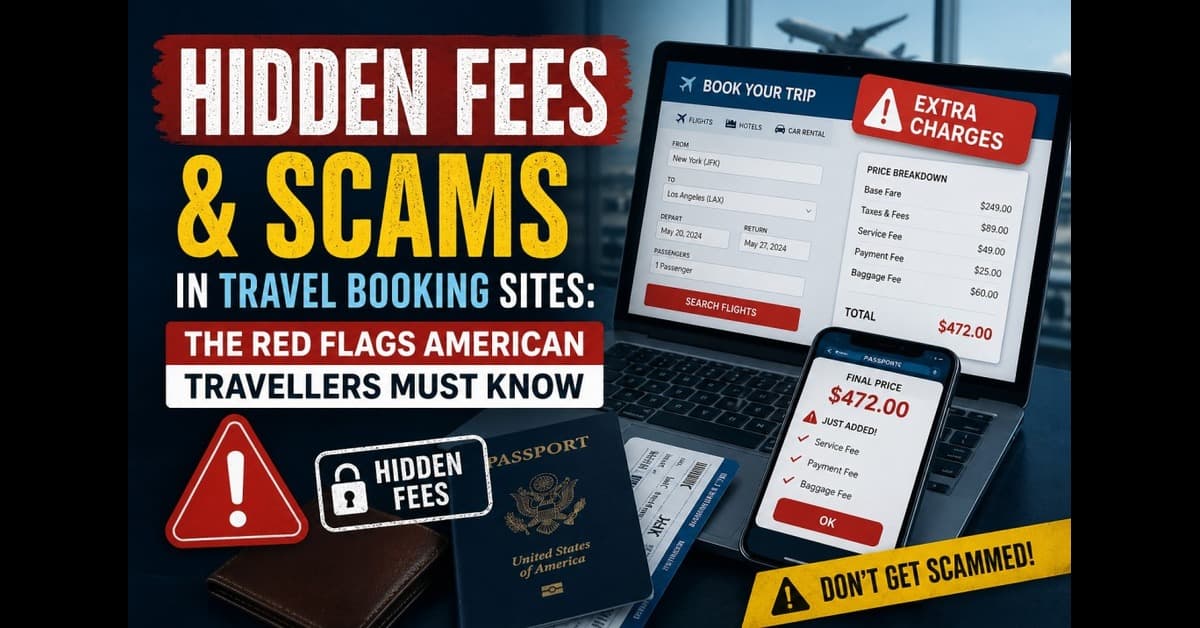
For American travellers, planning a trip used to mean a mix of excitement and hunting for the best deals.
Now, it also means protecting money and personal identity from a wave of highly sophisticated online scams.
Despite America’s Federal Trade Commission (FTC) working relentlessly against online fraud, reports from cybersecurity firms like McAfee reveal a staggering reality. They claim that over 35% of adult customers in the US have been scammed while booking online travel. In 2024 alone, financial losses worth $12.5 billion were reported to have taken place due to fraud.
The scammers use sophisticated tools to create fake, spoofed, or misleading online travel booking websites to steal money or passwords of victim travellers. They gather personal information of travellers and use it to steal their identity.
The level of sophistication they maintain in their malpractice is such that they can impersonate customer service voices and generate realistic emails at a scale and speed never possible before. Their methods are growing sophisticated in victimising susceptible adult targets (aged 18-29) and even older demographics.
The problem is not that travellers have to bear the brunt of traditional fraud, it is also being unable to identify a legitimate business from an AI-generated digital mirage.
To help you save money for your next trip and don't get duped by scammers, here's the list of primary scams, hidden fees, and red flags to watch out for.
Spurious website appearing legitimate
The digital landscape is infested with lookalike scams supercharged by generative AI models. The scammers use these technologies to copy legitimate travel brands, cloning their design patterns, logos, images, and everything in seconds. The overall appearance is such that you feel like you are looking at a genuine travel website.
Some travellers also experience being duped by fraudulent companies impersonating legitimate travel websites, tricking them into paying higher, hidden charges for services that do not even exist. The point is, these scammers are convincing in their approach to lure travellers through deceptive branding and then reveal costly, non-refundable charges once the booking is done.
Travellers also have to witness the bitter experience of fraud when they try to book directly with a major airline company's website but then are redirected to a third-party platform, which looks like the mirror image of the original website. The travellers realise their mistake of having fallen prey to the fake platform after they have completed the transaction, and then cancellation was impossible until they were charged a higher amount.
How it works
It works in a systematic behavioral pattern of customers. For example, you search for a flight or hotel and come across a website that looks similar to a reputed and branded airline company, hotel, or travel booking platform. You are glad to see that the imposter platform features' round-the-clock' service and some (AI-generated) testimonials glowing on it. Getting the impression that you are at a genuine platform, you start booking a flight, only to realize that your money went straight to a scammer's world.

Signs & Red Flags indicating you are dealing with travel scams
- If you look closely, you will notice that the fraud websites have slight variations or incorrect spellings of legitimate websites, such as "bookIng.com," etc.
- You will notice an unrealistic price. This means coming across a platform offering flight or hotel rates that are dramatically cheaper than what legitimate platforms offer. Scammers psychologically profile travellers who appreciate discounted fares or deals, believing that such deal hunters can easily be tempted.
- A flight ticket that looks far cheaper than what you see on legitimate sites like Skyscanner or Travomint. That's one of the red flags to look out for.
- When you come across or learn of a website through a social media ad or a random text link and search more about it, only to find no credible information to validate its legitimacy.
- When you are urged to wire transfer or pay in cryptocurrency. Genuine platforms do not maintain such practice, they prefer standard credit cards.
- Fraudsters lure travellers with urgency by urging them to hurry as the specific deals are going to expire in seconds. Legitimate companies may also urge you to hurry, but will not put pressure on you to use unsafe payment methods.
- Fake reviews, fake customer numbers, missing contact numbers, odd customer emails, and unclear refund or cancellation policies are also some of the red flags to watch out for.
One of the most important steps you can take to ensure you are protected from online travel fraud is taking an extra moment to verify the legitimacy of a site's credentials.
Misleading or fake listings and AI-generated images
Online scammers use AI image generators to fabricate the listings of hotels digitally to mask their actual states. When travellers arrive at one of these properties, they find that it barely looks like what they saw in the pictures of the listing. Many travellers also face situations where they arrive at a hotel that was different from the online photo they found on such a scammer's site.
How it works
Today's AI image-generating tools are highly advanced in creating realistic photos of almost everything and everyone. Scammers use these tools to clean up, enhance, or fabricate the details. For example, you may see that an online photo is showing a villa surrounded by a sun-drenched atmosphere and fascinating attractions nearby, but it may turn out to be a windowless basement or something annoyingly far different from the photo.
Why it happens
It happens because advanced AI tools can clone or recreate the tantalising fabrication of any dream tourist destination to cajole travellers into believing that they are going to marvel at the beauty of such (fabricated) destinations. Unfortunately, such tricks work most of the time as such manipulated listings appear even on a legitimate platform, as scammers use its reputation and brand name to appear genuine.
Phishing through automated spoofing and urgent alerts
American travellers are also targeted by spoofing attacks where scammers use AI and automated scripts to generate (fake but convincing) real-time booking and account alerts. One of the tactics involved here is credit card failure, where you receive an urgent text, warning you of your reservation at risk of being cancelled unless you pay the amount asked.
Another tactic is an AI-prompted phone call claiming that your flight ticket is cancelled, but you can rebook if you share the confirmation code and credit card details. The emails or text messages with links showing exclusive deals are also scams where you are urged to log in using your travel account or share your Google credentials to claim the deal.
Why it works
Unfortunately, such tricks often work as the message you receive looks like the exact replica of some real businesses, paired with stolen logos and real booking details from a data breach. In addition, the scam also feels genuine enough to rule out any doubt and suspicion you may have in the first place. The goal of such tactics is to tempt you to grant the scammers access to your identity, travel account, and financial credentials.
Bait and switch pricing scam
This is one of the most widely reported scams in which the scammers use AI-generated pricing engines to lure travellers in with initial low-priced fares. In this type of scam, travellers usually witness jacked-up prices when they are about to pay or have already paid. Most of the time, they are charged twice for basic services like baggage and seat availability. Travellers are also scammed with hidden service fees that appear on their bank statement after they have finalised the booking. Dynamic pricing traps are also one such scam where prices are inflated by hundreds of dollars at the very last stage of the checkout process under the pretext of high demand.
How it works
The AI-powered pricing and recommendation engines created by the scamming websites are designed in such a way that they algorithmically change offers in real-time, making it easy for them to lure travellers in with low teaser fares. Later, the scammers keep on adding fees one after another until the travellers feel compelled to rush to complete the booking.
The predatory operators who scam travellers are known for drip pricing, in which they lure customers in with a low initial price. Later, they add mandatory fees, a well-documented practice warned by the US regulators, including the Federal Trade Commission.
The reality is that many airlines, hotels, and online travel agencies leverage AI-powered revenue management systems. They dynamically adjust prices in real-time based on a host of factors, including high demand and browsing patterns of customers.
Unauthorised deduction, surprise charges
One of the troubles travellers often undergo is the realisation that their financial transaction is not done when they click on the "Confirmed Booking" button. This is the situation of encountering digital traps where booking systems display errors and ask users to restart the booking process to get a confirmed reservation.
However, what follows right after is an ugly fallout of automatic money deduction without receiving a confirmed reservation.
Worst of all, the victims can't even have their grievances resolved via customer support services, as they happen to be fake, run by AI bots who block access to any human representatives. Travellers have no way of reporting data breaches or getting refunds on unauthorised transactions.
How it works
Shady operators follow certain tactics to lure travellers in and fall for their tricks. They exploit your submitted credit card data to trigger charges not authorised before or hide behind complex processes to add fees. Sometimes, the scammers will charge you more under the pretext of “declined payment” without providing any context, a transaction receipt, or confirmation. Worst, you will also be denied a refund.
Why it works
The con operators or scammers use automation that allows them to move money with almost no obstacles or accountability. By using AI-gated customer support, they cast their safety net wide, making it impossible for customers to report fraud or unauthorized transactions.
Ghost bookings and the third-party trap
For American travellers who don't want to compromise their booking experience because of scammers, it is important to understand that ghost bookings exist as perhaps the trickiest form of online fraud.
Because they look too genuine to be denied. You can't invalidate them for being unreal. Unfortunately, you realise later that you have been scammed when you arrive at the airport or a hotel, only to find that there is no record of your reservation.
In some cases, travellers paid for their stay in full but found later that the hotel had no record of their booking upon arrival. This becomes an embarrassing situation for the travellers, forcing them to pay twice just to have a place to sleep.
Scams carried out through middlemen or third-party platforms are also worse, as they pocket hundreds of dollars in fees in the name of travel insurance and seat upgrades. However, you don't get the actual service for the price you paid. Sometimes, travellers are scammed with the promise of boarding passes that never arrive.
How it works
The con or shady operators get your payment for the booking but never finalise the reservation with the airline, hotel or other type of accommodation.
Why it works
When you book a flight or a reservation through a third-party middleman or agencies rather than dealing directly with the legitimate players like Travomint, MakeMyTrip, Skyscanner, you have no control of your money. In fact, it is these third-party scammers who control your money, not the real provider. At the end of the day, you feel stranded as the con agencies keep your cash instead of fixing your problems.
Don't forget that flight booking prices are also engineered using sophisticated algorithms based on metrics, such as demand, search frequency, and competitor behavior.
Why do fake travel booking sites appear cheaper than they really are?
Fake travel platforms indulging in the malpractice of scamming people know that low or discounted fares attract people's attention. So, these sites usually run ads on discounted fares without reflecting the final amount a traveller has to pay at the final stage of booking.
The problem starts when you get inflated charges after mandatory fees, seat charges, baggage costs, and payment processing fees are added. A sort of harrowing experience happens when you come across a hotel room advertised at $149 per night but costs you over $220 once you are asked to pay resort fees, taxes, and service charges at checkout.
Hidden Fees on Flight Booking
|
Fee Type |
What It Covers |
Typical Cost |
|
Checked Baggage Fee |
First or additional checked bags |
$30–$75 per bag |
|
Carry-On Fee |
Overhead cabin baggage on some budget airlines |
$25–$65 |
|
Seat Selection Fee |
Choosing your preferred seat in advance |
$10–$80 |
|
Priority Boarding |
Early boarding access |
$15–$50 |
|
Change or Cancellation Fee |
Modifying your reservation |
Varies by airline and fare class |
Hidden Hotel Charges
|
Fee Type |
Description |
Typical Cost |
|
Resort Fee |
Mandatory daily amenity charge |
$25–$60 per night |
|
Destination Fee |
Urban equivalent of resort fees |
$20–$45 per night |
|
Parking Charges |
Overnight self-parking or valet |
$25–$80 per night |
|
Early Check-In / Late Check-Out |
Flexible arrival or departure |
$30–$100 |
|
Wi-Fi Fee |
Premium internet access (less common today) |
$10–$25 per day |
Note - Fee amounts indicated in the table are not confirmed data. They may vary, depending on the travel providers, destinations, travel dates, and booking conditions. We urge readers to consult sources like the Federal Trade Commission, the U.S. Department of Transportation, and the Consumer Financial Protection Bureau for detailed and fresh insights.
Concluding Statements
Travel booking scams in America did not come into existence all of a sudden. Years of watching customer behaviors, exploiting security loopholes of vulnerable travel platforms, and leveraging AI technologies have enabled scammers to invent sophisticated tricks to scam travellers. In fact, modern scammers are using increasingly advanced methods to clone legitimate travel providers, manipulate pricing, and deceive even cautious travellers.
|
Warning sign |
What it may indicate |
Why it matters |
What you should do |
|
Prices far below market rates |
The offer may be fake, misleading, or loaded with hidden charges. |
Scammers often use unexpected low prices to attract quick bookings before travelers have time to verify legitimacy. |
Compare the total fare across reputable platforms and the airline or hotel's official website. If the price looks unusually low, proceed with caution. |
|
Payment Requested via Wire Transfer, Gift Card, or Cryptocurrency |
The seller may be attempting to avoid traceable, reversible payment methods. |
These payment options offer little to no consumer protection, making recovery of funds difficult if fraud takes place. |
Always use a major credit card, which provides chargeback rights and fraud protection. |
|
Poor Website Design or Frequent Grammatical Errors |
The website may be hastily created or operated by scammers. |
While not genuine on their own, sloppy design and language often mean a lack of professionalism and legitimacy. |
Review the site carefully and verify the company's credentials before sharing personal or financial information. |
|
No Physical Address or Verifiable Contact Information |
The business may not have a legitimate operational presence. |
Reputable travel companies provide clear contact details, including customer service numbers and business addresses. |
Search for the company independently and confirm its registration and customer support channels. |
|
High-Pressure Sales Tactics |
The seller may be trying to prevent you from researching the offer. |
Urgency is a classic fraud tactic designed to override rational decision-making. |
Take your time. Legitimate travel deals may expire, but trustworthy companies will not pressure you into unsafe transactions. |
|
Suspicious or Limited Online Reviews |
The company may be newly created, poorly established, or using fake testimonials. |
A lack of independent reviews can indicate limited credibility or deliberate reputation manipulation. |
Check trusted review platforms, consumer forums, and Better Business Bureau ratings. |
|
Misspelled URLs or Unusual Domain Extensions |
The website could be impersonating a legitimate travel brand. |
Fake websites often copy established companies using lookalike domains to deceive customers. |
Type the official website address manually rather than clicking links from ads or emails. |
|
Unwanted Calls or Emails About Booking Problems |
Scammers may be impersonating airlines, hotels, or travel agencies. |
Fraudsters often create panic by claiming payment issues, canceled reservations, or urgent itinerary changes. |
Contact the travel provider directly using contact details from its official website. |
|
Lack of Clear Refund or Cancellation Policies |
The company may make refunds intentionally difficult or impossible. |
Transparent policies are a hallmark of legitimate travel businesses. |
Read all terms carefully before booking and avoid companies with vague or hidden policies. |
|
Confirmation Email Seems Unprofessional or Incomplete |
Your reservation may not actually exist. |
Fake confirmations often contain missing booking references, poor formatting, or suspicious sender addresses. |
Verify the booking directly with the airline, hotel, or travel provider immediately after purchase. |
Even though the Federal Trade Commission (FTC) in the US continues to fight against online fraud, there is no scope on the horizon indicating that the travel scams will end forever.
In fact, the rampancy of their expansion targeting of travellers is a serious problem costing people enormous financial losses.
Meanwhile, industry research from companies like McAfee has reported that a large number of American adults still face online travel scams and hidden charges. The key takeaway here is that exercising caution is only a defense to battle against such scams. Going an extra mile in verifying a deal, reviewing the final price, and confirming a site’s legitimacy can prove extremely helpful in safeguarding both your money and travel plans.