
Best Travel & Hotel Booking Websites in the U.S. Ranked by Customer Satisfaction
Business to Consumer
April, 27, 2026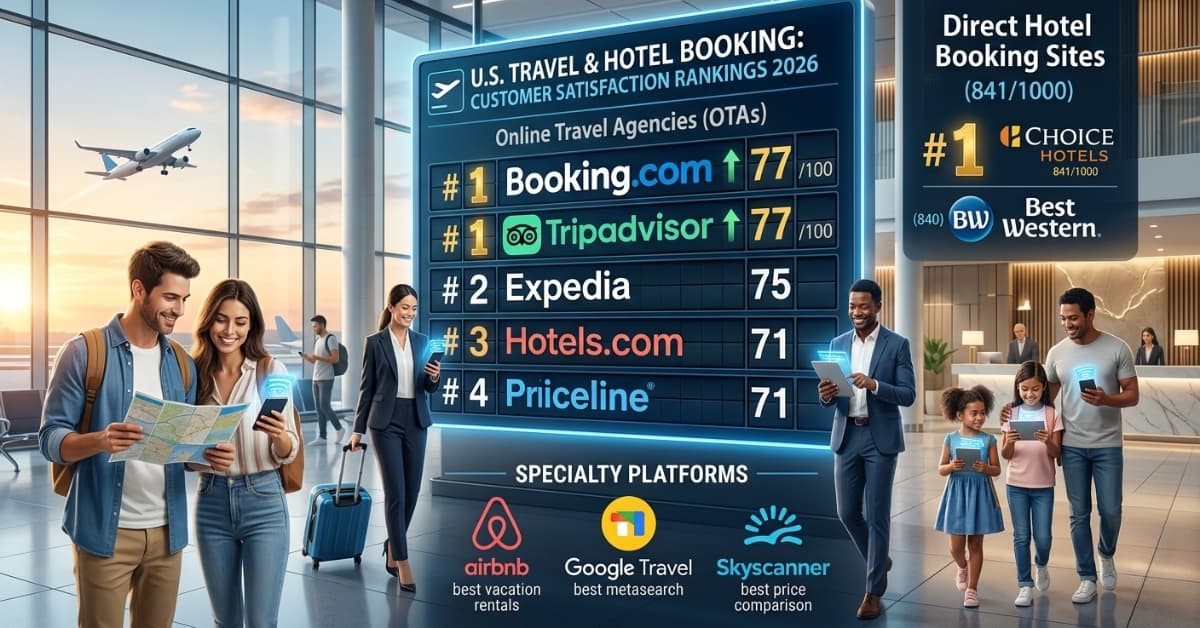
There's a moment every traveler knows well: you've got a trip on the calendar, your dates are locked in, and now you're staring at a dozen browser tabs — Booking.com, Expedia, Hotels.com, Priceline, Kayak — each one claiming to have the best deal. Where do you actually start?
The answer used to be simpler. A decade ago, you could pick almost any major online travel agency (OTA) and feel reasonably confident. Today, it's more complicated — not because the options have gotten worse, but because the gap between the best and the worst has widened considerably. And with real money on the line, "reasonably confident" doesn't quite cut it.
This article removes the noise using real, independently collected customer satisfaction data — primarily from the American Customer Satisfaction Index (ACSI), which has been benchmarking the travel industry for over two decades. We have also taken reference from Frommer's decade-long series of independent booking site tests, J.D. Power's North America Hotel Guest Satisfaction Index, and Qualtrics' 2025 consumer research study covering more than 15,000 U.S. travelers.
The picture that emerges is revealing — and in some cases, surprising.
The Big Picture: A Turbulent Year for OTAs
Before we begin analyzing separate platforms, it's worth understanding the industry backdrop. The ACSI Travel Study 2025 found that online travel agencies experienced a 3% decline in customer satisfaction which resulted in an overall ACSI score of 75. The situation might not appear serious, yet it demonstrates a real change in American attitudes toward third-party booking platforms.
The reason isn't hard to find. Hotels and airlines have spent the last several years dramatically improving their own direct booking experiences. Their apps are sleeker, their loyalty programs are more rewarding, and their customer service for direct bookers is markedly better. Consequently, more people now choose to avoid online travel agencies while those who continue using them expect better service.
However, the online travel agencies experienced their first recovery of operations since the start of the coronavirus pandemic. The American Customer Satisfaction Index Travel Study 2026 notes their score settling at 76, which is a 1% increase in score, supported by advances in AI-driven tailoring and more seamless loyalty program design.
Taking that context into account, here’s how the major platforms compare:
1. Booking.com — ACSI Score: 77 (2026) | Previously: 78 (2025), 80 (2024)
Best for: International trips, variety of accommodations, review depth
Booking.com has been the most-visited travel and tourism website in the world for years running — a standing supported by Booking Holdings' own corporate disclosures and corroborated by web traffic tracking services — and its customer satisfaction scores have reflected that dominance. It held the top ACSI spot among OTAs in both 2024 and 2025. In 2026, it slipped 1% to 77 but still effectively tied with Tripadvisor for the top position among reported brands, per the ACSI Travel Study 2026. (ACSI publishes category-level scores publicly; individual brand breakouts are reported where available in ACSI's public releases.)
What sets Booking.com apart isn't just its inventory — which includes nearly 30 million listings worldwide, spanning hotels, apartments, hostels, villas, and everything in between, a figure consistent with Booking Holdings' public corporate disclosures. It's the depth of information provided before you commit. Review systems are robust and, following a 2025 overhaul, now recency-weighted so that fresh guest experiences carry more impact than reviews from years past. There's also a strong free cancellation culture on the platform, and the Genius loyalty program has quietly become one of the better value propositions in the OTA space, offering tiered discounts for repeat bookers.
For U.S. travelers heading abroad, Booking.com genuinely has no peer in terms of inventory breadth. Its European penetration, in particular, is deep enough that you'll often find boutique properties that simply don't list anywhere else.
Where it loses points: Customer support may vary when things get disrupted, and discrepancies between hotel information and Booking.com’s records can lead to unpleasant customer experiences.
2. Tripadvisor — ACSI Score: 77 (2026) | Previously: 74 (2025)
Best for: Research-first travelers, review validation, transparency
Tripadvisor pulled off one of the more impressive rebounds in the 2026 data — jumping 4% to tie Booking.com at an ACSI score of 77. It's a meaningful recovery for a platform that had been sliding for two straight years.
Tripadvisor's core strength has always been trust. With over 1 billion reviews and opinions across accommodations, restaurants, and experiences — a figure the company confirmed publicly around 2023–2024 — it functions as something between a booking engine and a travel encyclopedia. According to Podium, a hospitality reputation management company (note: vendor-produced research, not an independent study), 87% of travelers say they form a better impression of a hotel when management responds thoughtfully to a negative review. Whatever the precise figure, this dynamic plays out most visibly on Tripadvisor's platform, where public owner responses to reviews have become an industry standard.
In recent years, Tripadvisor has developed into a complete booking platform because the company now depends less on its original function as a review aggregator. The previous results of the pivot showed mixed outcomes, but the current 2026 satisfaction data indicates successful implementation of the new method. The depth of user-generated content here gives travelers something most OTAs can't replicate — context. You're not just seeing a price; you're seeing thousands of unfiltered opinions from people who actually stayed there.
It's worth noting that Frommer's 2026 independent test found Tripadvisor no longer appearing as a standalone price-leader in its top rankings — industry consolidation has folded many familiar names under larger corporate umbrellas. But for using the platform as a research and verification tool before booking anywhere, Tripadvisor remains essential.
3. Expedia — ACSI Score: 75 (2026) | Previously: 77 (2025), 79 (2024)
Best for: Package deals, domestic travel, loyalty rewards
Expedia has had a rough couple of years on the satisfaction scoreboards. From a score of 79 in 2024, it slid to 77 in 2025 and then again to 75 in 2026 — a significant erosion for the brand that once defined the entire online travel agency category.
What's driving the decline? The ACSI data points to broader dissatisfaction with OTAs as airline and hotel direct-booking experiences have improved, but Expedia also carries the weight of being a platform many Americans have had a complicated history with. Customer service complaints — particularly around refunds and cancellation disputes — have been a persistent issue.
That said, Expedia functions as a highly effective booking system which provides multiple travel services. The system handles package deals which include flights, hotels, and car rentals with seamless efficiency that exceeds all other systems in the market. The One Key loyalty program which launched in 2023, connects Expedia, Hotels.com, and Vrbo through a unified rewards program constitutes a vital advantage for frequent travelers who use various hotel types. Frommer's reports that customers who sign up for membership on OTA platforms can expect to save between 4% and 6% yet actual savings depend on the specific property and its current inventory.
It's also worth noting Expedia's corporate scale: the group owns Hotels.com, Hotwire, Orbitz, Travelocity, Vrbo, and Trivago, among others. For practical purposes, this means searching Expedia and searching Hotels.com will often return very similar/overlapping inventory, so results are often very similar — though ranking, pricing, and promotions can still differ slightly.
4. Priceline — ACSI Score: 71 (2026) | Previously: 74 (2025), 76 (2024)
Best for: Last-minute deals, flexible travelers, VIP loyalty members, Express Deals
Priceline's ACSI score has slipped three years in a row — from 76 in 2024 down to 71 in 2026, with the latest study noting a rise in customer complaints alongside the decline. That trajectory matters and it's worth understanding. But it doesn't tell the whole story of what Priceline actually is for the traveler who knows how to use it.
The platform's real strength has always been in its deal-hunting architecture. Express Deals — heavily discounted hotel rates where the property is revealed only after purchase — are a genuine mechanism for savings, not just a marketing gimmick. For travelers flexible on brand but firm on location and star rating, the discounts can be meaningful. Priceline is also part of Booking Holdings, the same corporate family as Booking.com, Kayak, and Agoda, which means the backend inventory is among the deepest in the industry. For last-minute bookings — tonight, tomorrow, this week — Priceline frequently surfaces options that more rigidly structured platforms miss entirely.
The Priceline VIP loyalty program is also worth flagging. Frequent users who reach Gold or Platinum status unlock additional discounts on top of already-negotiated rates, and the program accumulates perks without the complexity of points conversion that frustrates many travelers on other platforms.
Where the satisfaction scores are telling the truth is in the opaque booking experience. The Express Deals model works beautifully when the revealed hotel matches expectations — and generates real frustration when it doesn't. Frommer's has noted that third-party tools exist specifically to help travelers identify mystery hotels before committing, which is a sign the experience has become more opaque than it needs to be. For travelers who value predictability and want to know exactly what they're paying for before checkout, Priceline isn't the right starting point. For deal hunters who can live with a little uncertainty in exchange for a lower bill, it remains one of the more honest bargain engines in the market.
5. Kayak — ACSI Score: 69 (2025) | Status in 2026: Not separately reported
Best for: Price comparison, flexible date searches, cross-platform research, travel alerts
Kayak occupies a fundamentally different niche than the platforms above. As a metasearch engine, it doesn’t process bookings itself but aggregates results from dozens of OTAs and directs you to the cheapest option. This structural difference defines both its strengths and its limitations.
On the research side, Kayak remains one of the most capable tools available. Features like Price Forecast provide guidance on when to book, while the Explore map and flexible date grid help travelers optimize trips around budget and timing. Price alerts are also well-implemented, making it easy to track fare movements over time. For travelers looking to scan the entire market quickly, Kayak delivers efficiency that few dedicated OTAs match.
The ACSI score of 69 reflects a structural tension rather than a product flaw. When issues arise after being redirected to a third-party site, responsibility can feel unclear — and that ambiguity often reflects back on Kayak. Frommer’s 2026 analysis also noted increasing overlap with Momondo under Booking Holdings.
Used as a research layer rather than a booking platform, Kayak remains one of the most valuable tools in a traveler’s toolkit.
6. Orbitz — ACSI Score: 66 (2025)
Best for: Travelers already enrolled in the Expedia One Key loyalty ecosystem
Orbitz had a difficult 2025, with its ACSI score dropping 10% to 66 — well below the OTA industry average of 75. A decline of this magnitude typically signals a meaningful shift in customer experience rather than normal variation.
The broader context is consolidation. Since its acquisition by Expedia Group, Orbitz’s inventory, pricing, and search infrastructure have largely converged with Expedia. In practice, searches across both platforms now return nearly identical results — same hotels, similar rates, and comparable filtering tools. For travelers without platform-specific loyalty, this overlap raises a clear question about differentiation.
Where Orbitz still holds relevance is within the One Key ecosystem. As part of Expedia’s unified rewards program, bookings made through Orbitz contribute to the same points balance as Expedia or Hotels.com. For users already committed to that system, Orbitz functions as an alternative interface with no loss of value.
The challenge is strategic clarity. Without a distinct feature set — whether through interface, inventory, or service differentiation — closing the satisfaction gap with Expedia will remain difficult.
7. Travelocity — ACSI Score: 74 (2025)
Best for: Traditional OTA experience, bundled travel bookings, straightforward planning
Travelocity represents a more traditional full-service OTA model, covering flights, hotels, car rentals, and vacation packages within a single platform. In the American Customer Satisfaction Index Travel Study 2025, it scored 74 — slightly below category leaders but within the mid-tier range of major booking platforms.
Travelocity functions as an established, more traditional full-service OTA model, which provides customers with access to its complete range of booking services — covering flights, hotels, car rentals, and vacation packages — through a single online platform. The system received a score of 74 which places it between category leaders and the mid-tier range of major booking platforms according to ACSI Travel Study 2025.
Travelocity uses the same inventory and system infrastructure that is common across the entire portfolio of Expedia Group companies, and hence its search outcomes tend to be highly similar to those of Expedia and Hotels.com. This makes the site suitable for use by individuals who would like access to both flights and hotels on the same platform rather than switching between specialized tools.
Its strength lies in simplicity and familiarity. The platform is designed for straightforward booking flows, with an emphasis on bundled trips that combine flights, hotels, and cars. For travelers planning complete itineraries rather than optimizing individual components, this integrated approach remains useful.
The trade-off is differentiation. The backend system of Travelocity which it shares with other Expedia Group platforms limits its ability to provide unique features except for its branding and interface preferences. The customer satisfaction ratings show that the product exists between two extremes: functional and reliable, but not leading the category.
Travelocity provides an all-in-one booking solution which delivers balanced services to travelers who prefer straightforward booking processes. For those seeking best-in-class pricing tools, review ecosystems, or loyalty optimization, higher-ranked platforms may offer more specialized advantages.
What Customers Actually Care About
A closer look at satisfaction metrics reveals a few consistent themes emerging across booking platforms.
- Transparency about fees is perhaps the single biggest friction point. "Resort fees," "property fees," and service charges added late in the checkout process consistently generate customer anger. Frommer's flagged this directly in its 2026 testing, warning that some platforms reveal fees only on the final booking page — sometimes doubling the apparent sticker price. A few platforms now fold these costs into search results upfront; those that don't are increasingly penalized in satisfaction surveys.
- Mobile experience is increasingly decisive, particularly among younger travelers. Qualtrics' 2025 proprietary study — covering more than 15,000 U.S. consumers between December 2024 and May 2025 — found that hotel guests aged 18–34 reported meaningfully lower satisfaction (76%) compared to the overall average of 84%). The same cohort prioritized mobile-first experiences and seamless self-service options — and OTA platforms that haven't invested seriously in their apps are paying for it in satisfaction scores.
- Review authenticity is a growing concern. Frommer's 2026 guide included an explicit warning that AI has made fake review generation easier and more convincing than ever, calling out platforms where fabricated five-star reviews have infiltrated public message boards. The platforms with the most credibility — Tripadvisor, Booking.com — are those that have invested most seriously in verification systems and enforcement.
- Customer service during disruptions remains the single hardest thing to get right. When a booking goes sideways — hotel overbooks, a room isn't what was pictured, a reservation disappears — how the platform responds determines whether a customer ever returns. This is where even well-rated OTAs frequently stumble, and where direct hotel booking still holds a structural advantage.
The Bottom Line
Start by using Hopper or Kayak to understand pricing, but do not book through them. These tools help you evaluate what a fair price looks like, identify the cheapest travel dates, and assess whether fares are likely to drop.
Next, choose your booking platform based on the nature of your trip. If you are traveling internationally, especially to Europe, Booking.com offers the widest inventory and meaningful long-term discounts. If you are planning a domestic trip that includes flights, hotels, and a rental car, Expedia provides the most streamlined bundling experience. If you need a last-minute booking and are flexible, Priceline is optimized for that scenario.
Before completing any booking, you should always check the hotel’s official website. This quick comparison will either reveal a better rate or confirm that you are already getting the best available price, and many hotel chains will match rates while offering additional loyalty benefits for direct bookings.
You should also be clear about your priorities. If minimizing cost matters most, online travel agencies are generally the better option. If reliability, customer support, and peace of mind are more important, booking directly with the hotel is the stronger choice.
Regardless of the platform you choose, you should always read the cancellation policy carefully and take a screenshot for reference.