
Yelp, Trustpilot & Google Reviews: A Comparative Analysis of The Review Platforms
Reviews and Ratings
May, 5, 2026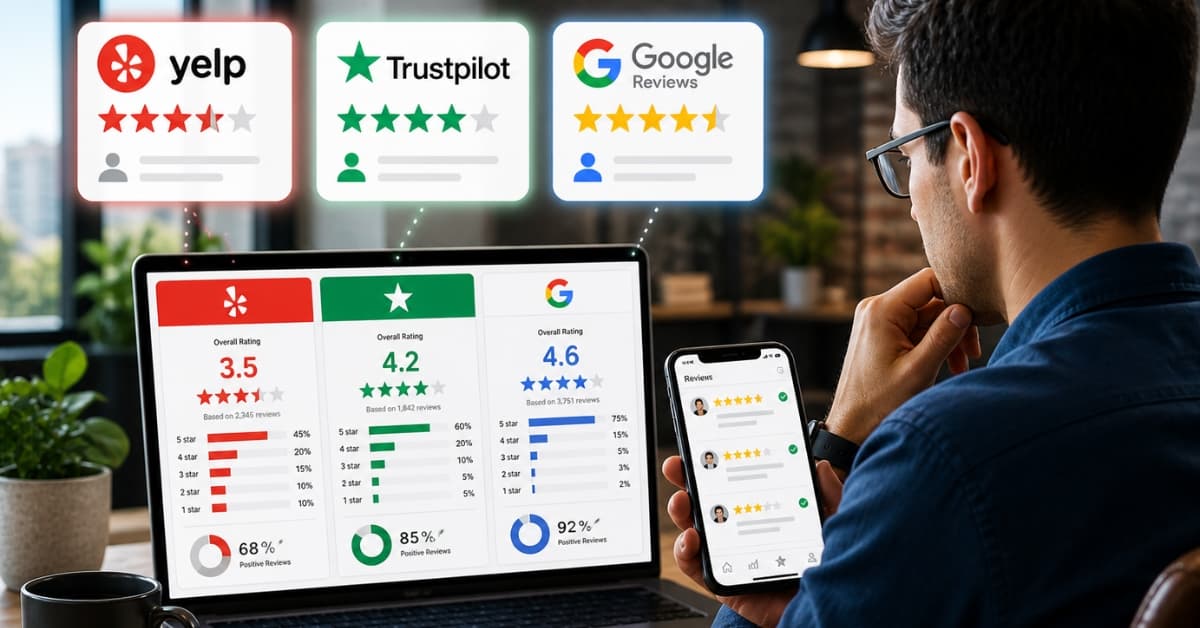
Consumers today view online reviews as instrumental in the way they make a decision about a brand. This simply means that a large number of people trust online reviews as a reliable go-to source to trust a brand or ignore it. In this context, the role of review platforms is important as a provider of authentic social proof to influence trust, perception, and decisions of people. Among the plethora of review platforms you see today, three names that stand out distinctly are Yelp, Trustpilot, and Google Reviews.
They are all operating with the same fundamental purpose of helping users make an informed decision about the standing or positioning of businesses. However, these platforms work in different ways. Based on how reviews are collected and modified to how they influence trust, each of these platforms enjoys an uncontested reputation of offering a unique lens through which consumers assess the reputation of businesses.

Source: Brightlocal.com
Based on this analysis, no doubt a question arises as to whether review platforms are equally reliable or whether we should focus on the source of the review as much as the review itself. Therefore, being clear about these review platforms in the first place is an intelligent approach, as doing so helps consumers make informed decisions about a brand and helps businesses manage their online reputation in a better way.
Overview of Yelp, Trustpilot, and Google Reviews
Yelp - A Trusted Resource For Reviews
Yelp is a trusted resource for reviews that operates based around the idea of facilitating local discovery. A crowd-sourced platform, it hosts user-generated reviews, photos, and ratings on local businesses such as restaurants, salons, contractors, cafes, and neighbourhood services. The platform, therefore, serves as a go-to resource or digital directory and social networking site for consumers, enabling them to discover, evaluate, and book, apart from reading detailed, experience-rich insights and interacting with business owners. The platform hosts users' uploaded photos describing and reviewing service quality. It guides consumers where to eat, shop, or seek local services, mostly in urban areas of the United States.
Trustpilot - Global Brand Reputation Platform
Trustpilot is a globally reputed, third-party digital platform broadly used by eCommerce brands, SaaS companies, and service providers as an open-access customer review site. It hosts user-shared feedback and reviews on businesses around the globe. Founded in 2007, Trustpilot is different from Yelp in the sense that it allows virtually anyone to leave a review about a company and allows businesses to manage their reputation. As of June 2025, Trustpilot, which operates as a freemium model, boasts over 330 million reviews from customers. It allows consumers free services and basic profiles for businesses, but charges for advanced analytics and marketing tools for reputation management and brand transparency.
Google Reviews - Search-Integrated and Worldwide Presence
Google Reviews is a world-renowned and most visible review system that hosts user-generated feedback and star ratings (1-5). Integrated into Google search and Google Maps, the platform allows customers to share experiences, search for nearby cafes for a global brand, and ratings. In fact, it is a default choice for people when it comes to verifying the credibility of a brand. Almost every industry and location around the world is covered in Google reviews, helping people make informed decisions and offering great assistance to businesses in building credibility. Other uses of the platform also involve local SEO rankings and managing online reputation for a brand.
Yelp, Trustpilot, & Google Reviews - Key Differences at a Glance
There is no denying that Yelp, Trustpilot, and Google Reviews do not have identical working mechanisms. They work differently in their respective goals and reach. Yelp, for instance, comes off as a platform designed for people who want to gain access to local, experience-based feedback. Therefore, Yelp essentially serves as a digital gateway to firsthand consumer experiences in varying natures, like generic or high-level information. From this explanation, the platform is a good choice for people looking for restaurants and service providers.
On the other hand, Trustpilot focuses on brand-level reputation, meaning it mostly focuses on the online businesses operating across different regions. It also acts as a universal layer of user-generated feedback that is now an integral part of everyday search behavior.
The significance of how these review platforms differ from one another is that it matters a lot, considering they influence how reviews are written, who writes them, and how much weight users assign to them. A detailed Yelp review may carry more insights for a dining experience, while a Trustpilot rating may improve your understanding of a company's overall service quality or brand positioning. Google reviews, more often than not, serve as a digital platform where reviews shared by consumers build initial impressions about a brand.
The Credibility of the Review Platforms and Trust Mechanisms
Yelp - The platform is best known for being a strict review filtering system where users are exposed to high-quality reviews, as the platform's automated algorithms filter low-quality and suspicious reviews. Therefore, what you get is user-generated feedback to improve your understanding of a brand. However, while filtering out reviews algorithmically may be a factor in improving trust, it can also lead to problems in terms of hiding legitimate reviews that may drive the fallout of frustrating both users and businesses.
Trustpilot - It is a digital platform best known for adopting a more open approach by allowing users to leave a review, and companies can invite customers to share feedback on the site. While the approach of the platform helps it maintain value and transparency, the downside of it comes in the possibility of biased or incentivized reviews. Trustpilot, however, ensures the removal of such possible downsides using reporting tools and moderation policies.
Google Reviews - Globally renowned and quite authentic in its nature of being a valid platform for hosting user-generated feedback, the platform serves as a digital entry point for quality reviews. Since it is tied to user accounts, the accountability of reviews is not questionable. The platform ensures that spam and fake reviews are removed. For this, it uses AI-driven systems; however, its spam filtering system is less aggressive compared to its counterpart, Yelp. As a result of this, users get to see a mix of review quality, ranging from detailed to brief one.
As a final analysis of this comparison among review platforms, we come to the conclusion that trusting any of them depends on the context of how they each operate. Having said that, Yelp is a platform that will give you an impression of a site that gives curated results. Trustpilot is more like a website famous for verified reviews and global credibility. Google Reviews are more like giving you the result for the purpose of localised SEO and high-volume visibility. So, each of the platforms operates differently and has its respective strengths.
Yelp, Trustpilot & Google Reviews - A Pros & Cons Analysis of The Review Platforms
Yelp - It boasts of having a high-intent user base due to its strict content integrity, with which it offers depth and authenticity in its reviews. However, it is not without some drawbacks, one of them is being an arbitrary filtering system that even blocks legitimate reviews. As it happens, the review platform often limits global reach and creates a smaller user base, disallowing solicited reviews.
Trustpilot - A review platform of global repute, Trustpilot excels in global accessibility, verified purchase tagging, and ease of review collection. Based on this operational tactic, it is trusted for its credibility among online shoppers and businesses. However, on the downside, the platform's open model sometimes becomes a cause of concern when it comes to verifying the authenticity of reviews. Moreover, the biggest downside of the platform is the rampancy of fake news, both positive and negative, damaging its global credibility.
Google Reviews - The review platform is appreciated for integrating daily search behavior to make way for incredibly powerful and quality reviews. From offering seamless visibility on search and maps to being free and easy for users, the platform serves search intent well for users. However, it is not without some cons, like limited customization and vulnerability to fake reviews. It also does not feature detailed user-generated feedback, causing a drop in its credibility.
Yelp, Trustpilot, & Google Reviews - Which Platform Is More Trustworthy?
For businesses, trusting a specific platform should be based on their target audience and operating model. For instance, locally operated businesses can build their profiles on Google and Yelp to drive more foot traffic that eventually impacts their businesses. Trustpilot and Google Reviews both these platforms command a sheer degree of trust and reliability among online businesses and global brands to build their authority in the long run. It is worth noting that trusting a single platform is risky because it will limit the scope for gaining full-fledged insights on a brand, especially if the reviews you come across are not authentic. In simple words, Google Reviews are trusted for local, everyday searches, Trustpilot for brand credibility, and Yelp for restaurants and services in the U.S. and Canada.
Bonus Content
Apart from Yelp, Trustpilot, and Google Reviews, other review platforms worth mentioning are: Facebook Reviews, Amazon Reviews, Glassdoor, TripAdvisor, and Angi. They can also be trusted to get informed of the online standing of brands and businesses, depending on your specific needs. For instance, Glassdoor is an information hub for employer branding, Amazon Reviews for e-commerce business, Angi for home services and contractors, and TripAdvisor for planning and booking trips.
The Bottom Line
Yelp, Trustpilot, and Google Reviews are some of the most famous review platforms on the digital sphere. Each works differently by maintaining their operational tactics. Despite differences, these platforms work with the common purpose of enlightening consumers, users, or businesses pertaining to a brand's standing.
|
Aspect |
Yelp |
Trustpilot |
Google Reviews |
|
Primary Focus |
Local businesses (restaurants, salons, services) |
Online businesses, global brands, SaaS |
All types of businesses (local + global) |
|
Typical Use Case |
Choosing where to eat or visit locally |
Evaluating online companies before purchase |
Quick validation of any business |
|
Geographic Strength |
Strong in the US, limited globally |
Strong global presence (Europe, US, Asia) |
Universal/global reach |
|
Review Style |
Detailed, experience-based, and often long |
Mixed (short + long), brand-focused |
Short, quick ratings with optional comments |
|
Ease of Posting Reviews |
Moderate (requires account, active users prioritized) |
Easy (open to anyone, invited reviews common) |
Very easy (via Google account, quick rating) |
|
Verification System |
Strict filtering algorithm |
Open system + moderation/reporting |
Google account-based + AI spam detection |
|
Trust Factor |
High (due to filtering) |
Moderate (depends on review source) |
Moderate to high (volume-based trust) |
|
Fake Review Control |
Strong but sometimes over-filters |
Moderate; relies on reporting tools |
Moderate; AI-driven but less strict |
|
Business Control |
Limited control over reviews |
High (can invite, respond, manage profile) |
Moderate (can respond and manage listing) |
|
SEO Impact |
Limited to the Yelp ecosystem |
Strong for branded searches |
Very strong for local SEO rankings |
|
Integration |
Standalone platform |
Standalone + website integrations |
Integrated with Google Search & Maps |
|
User Experience |
Community-driven, rich content, photos |
Clean, structured, brand-centric |
Fast, minimal, highly accessible |
|
Best For Consumers |
Deep insights into local experiences |
Checking the company's credibility online |
Quick decision-making |
|
Best For Businesses |
Local visibility and reputation |
Building global brand trust |
Driving visibility and discovery |
Yes, they are not without some downsides, including being infested with unverified reviews, yet their role as a digital word of mouth platform to build customer trust, improve brand reputation, and influence purchase decisions is unquestionable. Trust them for the satisfaction of getting verified information, not for isolated comments and reviews. Since these platforms work differently, it would serve you better if you know how each works in what respective way.