
Travomint vs Expedia: We Compared Both Platforms
Reviews and Ratings
June, 15, 2026
Mostly, travel platform comparisons you'll be viewing are written by people who have never booked anything. It's just written casually without any context. But this one is sure going to be different.
We ran the same search test on both Travomint and Expedia to answer one question: Which platform actually makes this easier?
Our Testing Methodology
- Route: Los Angeles to Abu Dhabi
- Travelers: 2 Adults
- Cabin Class: Economy
- Devices Used: Desktop and Mobile
This review covers everything, including search speed, pricing, fare transparency, baggage clarity, mobile usability, and which platform actually suits different types of travelers. We haven't just focused on comparing their feature lists; we have executed 8 rounds of head-to-head to get the full breakdown.
Round 1: The "First Click" Test
Before we jump into price comparison, website filters, and baggage policy, we focused more on: How many steps does it take to go from opening the platform to seeing actual flight results? It's like you're landing on the homepage of any travel website and still figuring out where to even start your destination for 30 seconds. Was it something you faced with Travomint or Expedia?
We opened both platforms at the same time on the same device (Desktop).
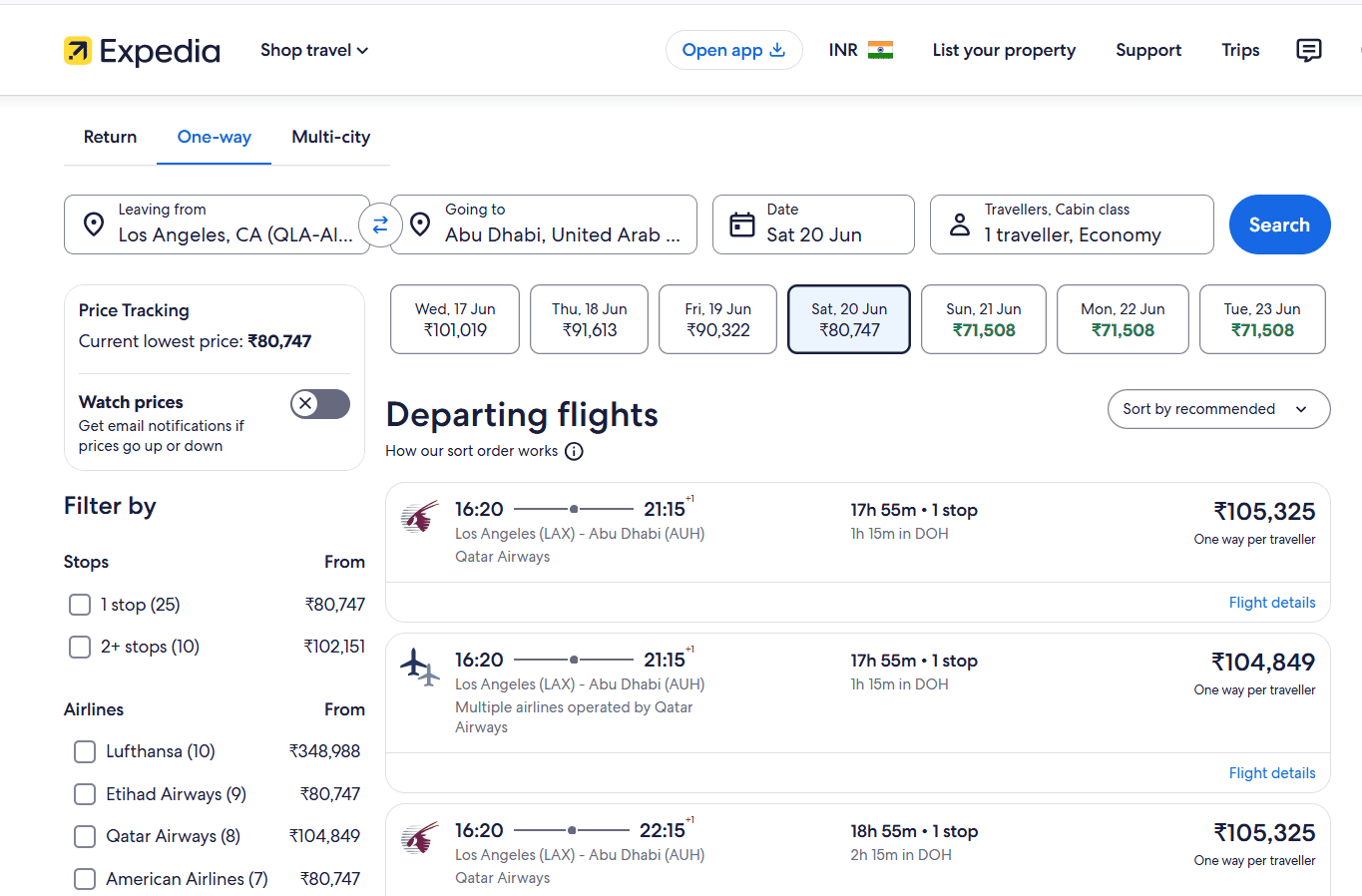
On Expedia: You get a variety of options, including stays, flights, cars or packages. This is the homepage built for travelers who want everything in one place and for family planning that makes sense,e and it's actually beneficial. Now our main goal is to test the flight experience, so we have to opt for the Flights option and then search for your route over there.
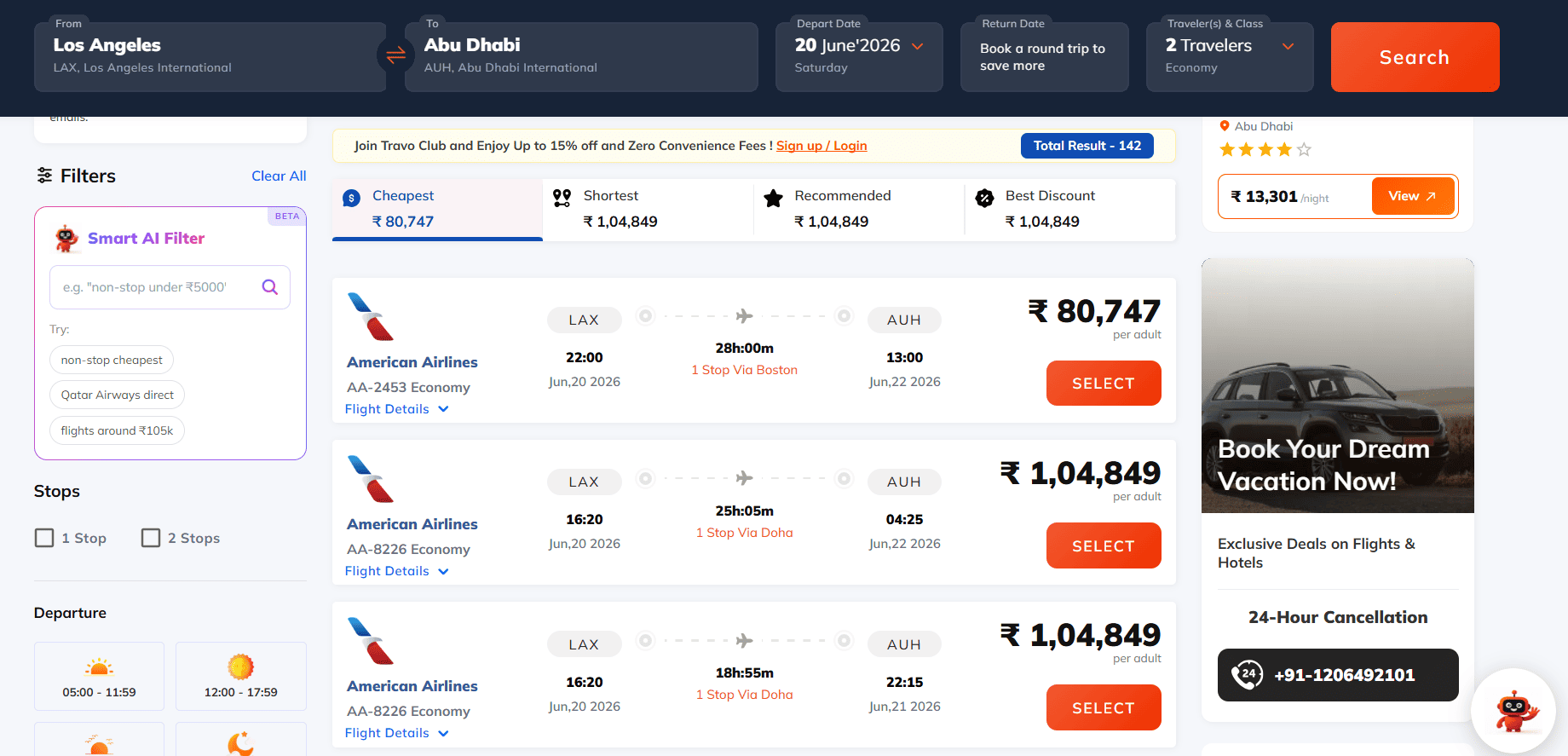
On Travomint: The flight search bar is on the homepage itself. You don't have to take an extra step to choose any category, like flight, hotel, or car, which you did on Expedia. Just type your destination, dates, and passenger count, and proceed further.
Final Say: Travomint has us looking at results roughly 20 seconds faster because it removed one decision step from the process.
Round 2: The " Can I Actually Find a Flight I Like?" Test
In this round, our challenge will be to find three flights within 5 minutes, which will be genuinely considered. Here, genuine consideration is followed not by the fastest, cheapest, but by the options that a reasonable traveler would pick up.
Los Angeles to Abu Dhabi is a 16,000+ kilometer journey; it's not like booking a domestic hop. Identifying the layover city, duration matters.
We evaluated both platforms across four specific criteria in this round.
1. Flight Variety: Both platforms provided a healthy number of results for this route. From both, we get a solid mix of airlines, multiple departure windows, one-stop, and two-stop options. Airlines operating these routes give options connecting through Middle Eastern hubs, European cities, and South Asian airports. Although Expedia's results were not the cheapest and shortest ones. But with Travomint, we sorted by price, and the cheapest fare moved to the top without the page reshuffling in a confusing way. To be honest, this was the best filter.
2. Departure Time Visibility: On Expedia, departure and arrival times were visible on each result card. On Travomint, the time display was more prominent per card, making it easier to quickly eliminate flights that didn't work for our schedule without clicking into each one individually.
3. Filter Functionality: Expedia comes with filters like stops, airlines, departure time, arrival time, duration, and airports. On Travomint, results were faster after each selection. Applying multiple filters at Expedia requires scrolling back up to confirm selection.
4. Layover Information: Expedia sometimes requires expanding the result to see the specific connecting airport. Travomint displayed this information directly on the card in most cases. For a traveler comparing a Dubai layover versus a Doha layover versus a London Layover, that upfront visibility saves multiple clicks.
Round 3: The "Will This Cost More Than Expected?" Test
Every traveler has been in that place where you get a flight fare of $680. You click it. You go through the steps and get the final payment screen, and the number displayed is $847. The difference of $167 appeared out of nowhere. Taxes, fees, booking charges, and service charges must be included in the fare ticket, but somehow they weren't part of the price they showed you first.
On Expedia, the fares that were shown earlier were different from what we saw at the final booking, though the base fare, taxes, and fees were listed separately.
On Travomint, the fare breakdown appeared earlier in the process. Before you dive into selecting seats or adding extras, the base fare, taxes, and total are visible in a straightforward layout. The final checkout number matched what we expected based on what we'd seen earlier in the flow.
Note: However, no platform hides costs intentionally in our experience. But one platform made those costs easier to see without having to look for them.
Read Also: Direct vs Connecting Flights: Save Time or Money? Pick the Best Option
Round 4: The "Hidden Cost Test"
No one just books a flight. You may want to know about the baggage details. Pick a seat that isn't the middle seat in the back row next to the bathroom. A Los Angeles to Abu Dhabi flight is not a small financial commitment. And at some point during the booking process, both platforms may present you with options, upgrades, and add-ons that will affect your final total.
1. Checked Baggage Visibility: A checked bag on an international long-haul route can add anywhere from $60 to $150+, depending on the airline and fare class. The distinction between baggage-included and baggage-not-included fares was visually clear on both Expedia and Travomint.
2. Seat Selection Pricing: We find neither platform aggressive about forcing seat upgrades. Both offered seat selection as a paid add-on for most economy fares on this route.
3. Travel Prediction: On Expedia, the insurance option was smartly placed with a pre-selected or prominently suggested state. On Travomint, it was present but felt slightly less pushed. In both cases, travelers should read the coverage details carefully before adding, but neither platform made opting out difficult.
Round 5: The "What If My Plans Change?" Test
Nobody books a flight just to cancel it, but somewhere between clicking confirm and actually boarding the plane, things happen. It may be a work emergency, a family situation, a visa complication, or a health issue. In our situation, from Los Angeles to Abu Dhabi, it is not a small stakes situation. The pre-booking experience:
On Expedia, it gives you access to fare rules. They were findable. Travelers don't pause while browsing,g and pausing to read fare conditions requires actively resisting that momentum. We find out what the rules are, and when they need to use them.
On Travomint: Fare flexibility indicators appeared earlier. The conditions weren't buried at the bottom of a details page; they were part of the fare presentation itself.
A traveler who sees "non-refundable" before booking makes a different decision than a traveler who finds out after. They might buy travel protection. Choose a different fare. They might book a different date with more flexibility built in. So, by doing it that way, providing information early isn't just being transparent. It's actually helping travelers make better decisions.
Round 6: The "Long-Haul Reality Check" Test
This is a much-needed test because cheap fare means nothing if the journey is brutal. We have judged both on four itinerary quality criteria that are specifically for long-haul travel. The difference between a 17-hour total journey and a 26-hour total journey is enormous for passenger comfort, especially for those who are traveling with family or older travelers.
Expedia: Itinerary Range Found
|
Itinerary |
Layover City |
Layover Duration |
Total Travel Time |
|
Best Option |
Dubai (DXB) |
2 hrs 20 mins |
19 hrs 45 mins |
|
Mid Option 1 |
Doha (DOH) |
4 hrs 35 mins |
23 hrs 10 mins |
|
Mid Option 2 |
London (LHR) |
5 hrs 50 mins |
24 hrs 30 mins |
|
Longer Option |
Istanbul (IST) |
9 hrs 15 mins |
26 hrs 40 mins |
Travomint: Itinerary Range Found
|
Itinerary |
Layover City |
Layover Duration |
Total Travel Time |
|
Best Option |
Dubai (DXB) |
2 hrs 10 mins |
19 hrs 30 mins |
|
Mid Option 1 |
Doha (DOH) |
3 hrs 40 mins |
21 hrs 55 mins |
|
Mid Option 2 |
Abu Dhabi via Riyadh |
4 hrs 20 mins |
23 hrs 45 mins |
|
Longer Option |
London (LHR) |
6 hrs 30 mins |
25 hrs 50 mins |
Travomint represented a shortened best-case itinerary in our test, giving clearer duration filtering and layover information visible without expansion.
Read Also: Airline Industry Trends 2026: What Every Traveler Should Know
Round 7: The "Trust Test"
Trust in an online booking platform is important, I must say, very important. We evaluated both platforms across five trust signals at the pre-payment stage because it gives a clearer picture of every platform:
1. Airline Information Clarity: If an airline name is displayed clearly, it must be trusted. Both Expedia and Travomint had built their trust by winning this category.
2. Fare Breakdown Visibility at Checkout: Travomint wins here because the fare breakdown is visible at checkout at an earlier stage in the booking flow itself.
3. Cancellation: The fare conditions are not buried at checkout, though they're easily accessible via a link on the booking page.
4. Platform Contact Information: If something goes wrong, travelers need to know what's next, and for that, contact information is a crucial thing that should be available at every travel platform. Expedia's customer service infrastructure is more extensive by virtue of scale.
5. Booking Confirmation Clarity: Both platforms provided clear confirmation screens and emails in our test.
Round 8: The "Who Is It Actually Best For" Test
Seven rounds have cleared one thing: neither of the platforms dominates universally, as each is followed by its own strength that fits directly to a specific type of traveler.
- Budget Travelers consider Travomint.
- Vacation Planner is Expedia's strongest category
- Family Traveler considers Travomint for flights, Expedia for the full trip
- Business Traveller considers Expedia for flexibility, Travomint for speed
- International Traveler considers Travomint
- Flight-Only Travelers consider Travomint
Final Say
After eight rounds of evaluation, the best and honest conclusion I can draw is:
Expedia carries a 1.2 rating on Trustpilot from over 11,851 reviews, which you can consider as a big number, revealing travelers sharing their own experiences. Because the rating is on a large scale. Meanwhile, Travomint holds a 3.8 rating on Trustpilot from 924 reviews. Although the comparison is smaller because it is a growing platform and not a decades-old travel giant, the results are still positive and more satisfying. Both contain negative reviews, but the ratio tells a different story.
On the evidence available, both from our testing and from thousands of traveler reviews, Travomint is currently earning that outcome more consistently for flight-focused travelers.