
Airline Industry Trends 2026: What Every Traveler Should Know
Business to Consumer
April, 29, 2026
The year 2026 is not less than a period of transformative phase for the airline industry. From adapting to evolving needs of travellers and technological innovations to addressing operational challenges efficiently, the aviation industry is sparing no pains in redefining the way people travel. It is making a great deal of investment in technologies and services, from AI and sustainability initiatives to biometric boarding and dynamic pricing, all tied to the purpose of improving their operational efficiency while maintaining customer satisfaction in the best professional spirit.
At the same time, passengers are also becoming more informed, value-conscious, and selective about where to spend their money, as far as travelling is concerned. Gaining profound understanding about these developments is a surefire way to make better decisions, especially in the context of avoiding confusion of how to save money and enjoy a hassle-free in-flight journey by choosing the right carrier.
Keeping that in mind, we are serving you this write-up as a constructive guidebook to keep up with the latest airline trends to improve your travel experience, whether you are a frequent flyer for business purpose or occasional one for leisure.
Airline industry trends 01 - Low-cost carriers continue to be the growth engines for airlines
As a traveller, you may think that only big names like Delta Airlines, American Airlines, Lufthansa, and United Airlines are some of the most powerful players dominating the aviation industry today. However, their little counterparts such as EasyJet, Ryanair, AirAsia, JetBlue, IndiGo, and Southwest Airlines are also dominant players in their own respective manners. Ignoring their contributions to powering the growth of the industry would be a gross misunderstanding. Having said that, the low-cost carriers may not have widescale networks connecting passengers to domestic and international destinations, but they spread their wings wide enough to accommodate the needs of flyers.
|
Rank |
Airline |
Code |
ASKs |
Global Share of LCC ASKs (%) |
Domicile |
|
1 |
Southwest Airlines |
WN |
258,787,551,391.00 |
11.00% |
USA |
|
2 |
Ryanair |
FR |
222,578,572,833.00 |
10.00% |
Ireland |
|
3 |
JetBlue |
B6 |
125,968,773,545.00 |
6.00% |
USA |
|
4 |
IndiGo |
6E |
119,765,885,098.00 |
5.00% |
India |
|
5 |
easyJet |
U2 |
111,439,911,654.00 |
5.00% |
United Kingdom |
|
6 |
Spirit Airlines |
NK |
92,025,776,854.00 |
4.00% |
USA |
|
7 |
Wizz Air |
W6 |
73,574,936,382.00 |
3.00% |
Hungary |
|
8 |
Volaris |
Y4 |
60,537,085,892.00 |
3.00% |
Mexico |
|
9 |
Frontier Airlines |
F9 |
57,215,224,264.00 |
3.00% |
USA |
|
10 |
Lion Air |
JT |
51,742,760,127.00 |
2.00% |
Indonesia |
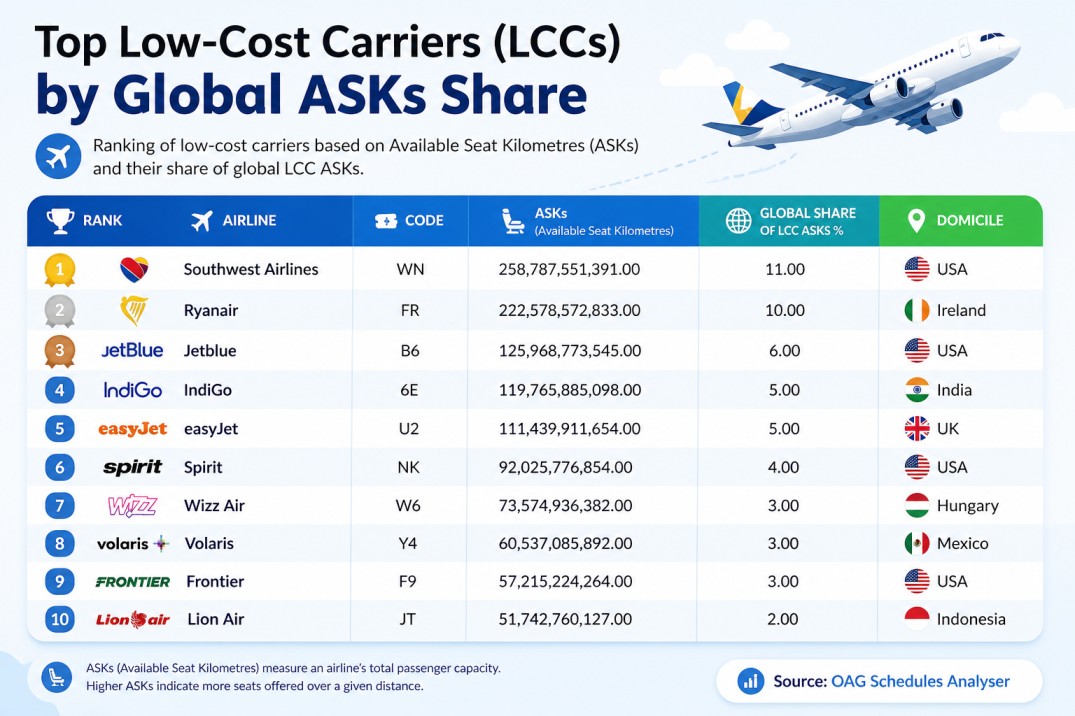
The reason low-cost carriers are one of the industry trends is because they are considered more affordable than their legacy counterparts, and it matters. Because when costs are kept low, it affects everything about the airline. For example, it affects where the airline flies, what its products look like, dynamic of sales, and onboard services etc. To say otherwise, these small yet wonderful players are growth engines for the industry as they cut short on operating costs by following the process of efficient operations, including unbundled pricing, and maximising aircraft utilisation.
Airline industry trend 02: AI-assisted airlines to gain traction more than ever
This is going to be one of the trends that will redefine the airline industry regarding developments in different operational areas. For example, the use of AI is set to be a key player in engineering benefits, in terms of fixing delays and flight irregularities that impact airlines, airports and passengers alike. Also, almost 60% of all flight delays are industry-related and systematic challenges. And don't forget that if one flight doesn't maintain its punctuality or on-time performance, it triggers a chain reaction of disruptions throughout the schedule. For example, the report by Airline for America reveals that flight delays cost nearly $100 per minute, according to 2024 industry data.
AI will be a game changer in this context based on the use case of how Air India has deployed agentic AI systems to handle 97% of all customer queries without requiring human interference. Another agentic AI system used by the airline is proving efficient in reducing transaction time by up to 90%. The point is, artificial intelligence is no longer the concept of a dystopian future but is practical and has been integrated into almost every aspect of airline operations and customer interactions, as proven in the example of Air India. From optimizing flight schedules to predicting maintenance requirements and improving route planning, the application areas of AI in the airline industry are wide.
Airline Industry Trend 03: Longer narrow-body flights
Rapid innovations in aircraft technology have been pivotal single-aisle jets, enabling them to fly routes that were once reserved for wide-body aircraft. This is the shift giving a new shape to global route networks, airline economies and the passenger experience. To understand why this trend matters in the airline industry, we need to take a look at the past performance of narrow-bodied aircraft like the Boeing 737. These aircrafts were reserved for serving short-and medium-haul routes. However, their modern counterparts like Airbus A321XLR and Boeing 737 MAX are playing instrumental roles in changing the dynamics of route networks.
It should be noted that in 2025, there were around 44,400 narrow-bodied flights which is a surge of over 18% compared to 2024. This simply means that the trend of narrow-bodied flights gaining traction and becoming more mainstream is already in the offing. One of the reasons behind this is increased efficiency and greater range of the narrow-bodied flights like A220 and B737 MAX, resulting in greater cost-savings and efficiency gains. Apart from fuel efficiency and lower costs, the new generation narrow-body aircraft are 20% more fuel efficient compared to their legacy models, making long-distance flights more affordable and economically viable. One of the other benefits of such narrow-bodied flights is being ideal for routes that are not popular in demand, which then becomes good for airlines to maintain high seat loads factors, including avoiding empty seats.
Airline industry trend 04: Sustainability and fuel innovations
In 2026, efforts are being made to make air travel decarbonised by adopting sustainable aviation fuel (SAF) and evincing a significant degree of advancements in alternative propulsion technologies. These efforts boil down to accomplishing a common goal of Net Zero emissions, along with better operational efficiency through precision data to balance climate goals with economic realities. It is worth noting that the international civil aviation organisation is giving its full support to its goal of achieving net zero aviation by 2050, despite challenges on the front of rising clean technology costs, geopolitical disruptions, and trade tensions while also seeking to double down on safety, operational efficiency and affordability. The reason SAF is given so much global limelight in achieving net zero emissions is because of its ability to reduce lifecycle CO2 emissions by up to 80% in contrast to traditional jet fuel. Moreover, it is also compatible with modern aircraft engines and infrastructure and a key catalyst for scalable solutions in decarbonising aviation.
Airline industry trend 05: Airlines to Navigate geopolitical events, at a cost
Though airline companies usually prefer to keep their skies free of any conflict, there is a growing pressure to adapt to geopolitical risks, an indication of rising trend in the aviation sector. It is also true that geopolitical events like wars, diplomatic disputes, sanctions, or airspace closures are beyond airlines to control, but they are directly or indirectly affected by these events. An industry that is globally pervasive, it is common for the aviation sector to feel the impact of political tensions taking place in any part of the world. It is true that the aviation industry is known for its flipping capacity of shifting aircraft, crews and resources from disturbed markets to more profitable routes, but this flexibility is not without some costs, including higher fuel consumption and temporary revenue losses. Despite these problems, adapting to geopolitical events is a competitive necessity for airlines in a world that is increasingly unpredictable to sustain customer confidence.
Top airline industry trends - Other honorable mentions
- Cybersecurity and digital identity - As airline companies are adopting biometric boarding, facial recognition and mobile-first services, it has become the utmost responsibility for them to ensure iron-clad protection of their passenger data and digital systems from cyber threats. Strong cybersecurity measures, therefore, are becoming next trends for the aviation industry to safeguard sensitive data like passports, payment details, and loyalty accounts against data breaches and cyber frauds. Deployment of digital identity technologies makes way for enhanced security, faster airport processes and seamless travel experience. This trend is also legitimate, given the rising importance of convenience and security going hand in hand in today's modern aviation sector.
- Precise and responsive pricing systems - This is another airline industry trend 2026 because pricing systems in the airline industry have become far more precise and responsive than they were. Now, airlines can swiftly make multiple price changes in minutes instead of updating fares a few times a day. For the industry, the trend is an indication of building a strategy to stay ahead of the curve in a highly volatile market. For travellers, it signals the necessity of staying alert about fares and being flexible with dates.
- Premium Economy - Being the industry's most profitable cabin class, Premium Economy, as per the trend, is sought-after by (long-haul) travellers looking for a middle ground between Economy and Business class, at a more accessible price point, offering the best balance of comfort and value. The airline industry is expanding the Premium Economy, given its increasing demands among both corporate and leisure travellers.
- Loyalty programs becoming lifecycle ecosystems- Frequent flyer programs are no longer limited to being just miles earned through flying. They are now becoming lifestyle ecosystems, rewarding travellers across different spending categories, with opportunities like hotel stays, dining programs, retail partnerships, credit card purchases, etc. This trend would mean encouraging travellers to accumulate rewards faster, even though they are not flying regularly.
- More focus on operational reliability - The aviation industry can't afford any factor jeopardising its operational reliability, and to keep it that way, airlines are focusing heavily on predictive maintenance, weather disruption forecasting, and automated recovery systems, etc. to reduce cancellations, cut short on delays, and make better overall punctuality. Maintaining operational reliability is becoming a fast-trending development in the aviation sector today.
Winding up
The aviation industry is eying for the future that is more passenger-centric, innovative and competitive than they have been. Efforts are being made to streamline operations and improve operational reliability using cutting-edge technologies, including focusing on deploying cybersecurity measures and digital identity technologies for robust security against cyber threats.
The intensive focus is given on maintaining sustainability to achieve net zero emissions, as a part of the common commitment of worldwide aviation industries to eliminating all carbon dioxide emissions from flight operations by 2050. In addition, personalising the passenger experience is one of the priorities airlines are undertaking as a mission-critical effort to deliver faster and more convenient travel experience. For passengers, the aviation trends signal great opportunities, including the fact that they are in for experiencing enhanced security and more convenient travel.