
Amazon vs Walmart vs Temu: Which One Is Trusted by Customers in the U.S.?
Business to Consumer
April, 28, 2026
U.S. shoppers are reading more reviews than ever before making a purchase — but which platform earns their loyalty once the order arrives? We analyzed the ASCI scores, refund data, review integrity, fee structures, and the seismic shift in tariff that just changed the game forever.
Every morning, millions of American shoppers open their phones and do the same thing before pressing "Buy Now" — they scroll the reviews, one-star complaints, verified purchase badges, or photos of what actually arrived. It is arguably the most honest form of consumer research available. And the platforms that earn trust in those review sections are winning something far more valuable than a single sale.
The three names dominating that battleground right now are Amazon, Walmart, and Temu. Each has a radically different origin story, business model, and customer promise. And in 2025–26, with U.S. trade policy having just redrawn the entire competitive map, the trust gap between them is wider — and more consequential — than it has ever been.
The Three Contenders: Who They Are
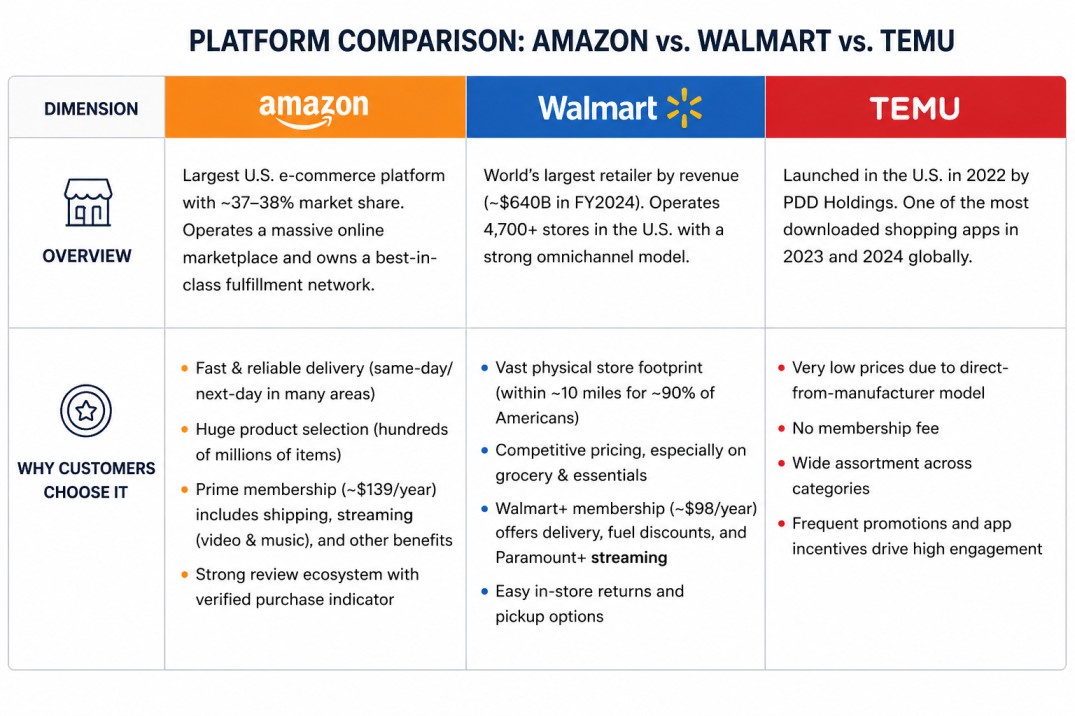
Before the data, you should be aware of the context. These are not three versions of the same business. They are three fundamentally different companies competing for the same wallet — and understanding what each one actually is explains why the trust gap between them exists in the first place.
Amazon
.png)
Founded by Jeff Bezos in Bellevue, Washington as an online bookstore, Amazon has become the biggest e-commerce platform in the U.S., holding about 37-38% of all retail online purchases in the nation as of 2024, according to eMarketer data. Its marketplace hosts over two million active third-party sellers worldwide. The firm operates over 200 fulfillment centers nationwide. Launched in 2005 as a $79 annual subscription for shipping services, Amazon’s Prime service has become one of the broadest retail ecosystems ever created in terms of video and music streaming, food and drug store deliveries, and even same-day logistics. Amazon is not just an online shopping site. It is the backbone of U.S. e-commerce.
Walmart
.png)
Founded by Sam Walton in Rogers, Arkansas, Walmart became the world's largest company by revenue — a position it still holds, with annual revenues exceeding $640 billion as of fiscal year 2024 per its own annual report. Its U.S. footprint of over 4,700 stores means roughly 90% of Americans live within 10 miles of a Walmart location. Its serious e-commerce investment only accelerated after its $3.3 billion acquisition of Jet.com in 2016. Walmart+ launched in 2020 as its direct answer to Amazon Prime. Walmart is a company of unmatched physical dominance that is still in the process of converting that dominance into digital trust — a conversion the ACSI data shows is far from complete.
Temu
.png)
Temu launched in the United States in September 2022 as the international arm of PDD Holdings — the Chinese e-commerce conglomerate that also operates Pinduoduo, one of China's largest shopping platforms. Its model was unlike anything U.S. shoppers had seen: a direct-to-consumer marketplace connecting American buyers with Chinese manufacturers, cutting out every layer of the traditional supply chain. Prices that seemed almost fictionally low were real — subsidized by PDD Holdings and enabled by the de minimis loophole that allowed sub-$800 packages to enter the U.S. duty-free. Temu became the most downloaded app in the United States in 2023 and held that position through 2024, per the ACSI's own published research. Its rise was one of the fastest in U.S. retail history. Its exposure when that regulatory ground shifted in May 2025 was equally dramatic.
Three companies. One founded in a garage. One built on small-town America. One assembled from a Chinese supply chain and a tax loophole. The trust story that follows is inseparable from the origins that shaped them.
The Numbers: Where Customers Actually Stand
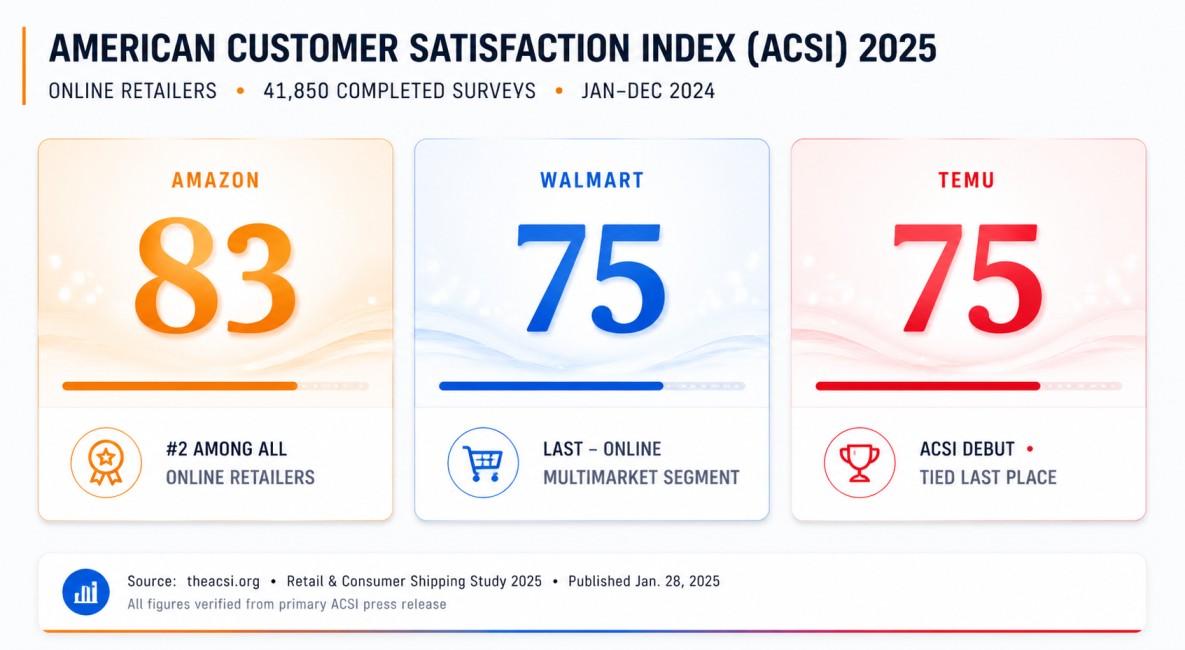
The gold standard for measuring U.S. consumer satisfaction is the American Customer Satisfaction Index (ACSI). Based on 41,850 completed surveys conducted between January and December 2024, the ACSI's 2025 Retail Study found that Amazon held an ACSI score of 83 out of 100 — second only to Chewy (85) among all online retailers. Walmart, competing in the same online multimarket segment, scored a 75 — last place. Temu, making its ACSI debut, also scored 75, tying Walmart at the bottom despite being the most downloaded shopping app in the U.S. for two consecutive years.
The ACSI's own words in its official press release say it most plainly:
"Despite being the most downloaded app in the United States for the past two years, Temu debuts with an ACSI score of 75, trailing many of its direct competitors in terms of customer satisfaction"
— American Customer Satisfaction Index (ACSI), Retail & Consumer Shipping Study 2025
Context matters here: Downloads reflect curiosity and aggressive marketing spend. Satisfaction reflects whether the experience matched the expectation. For Temu, the gap between those two metrics is enormous and revealing. Millions of people download Temu because it offers products at prices that seem almost fictionally cheap. However, being the most downloaded app and being the most trusted are not the same thing. In 2025, Temu learned that distinction at significant cost.
Walmart's score of 75 carries a different weight. Unlike Temu — a young platform still finding its operational footing — Walmart is a century-old retail institution with more resources, physical infrastructure, and consumer familiarity than almost any brand in the world. Scoring last in the online multimarket category, and 73 in the General Merchandise/Hypermarket segment, is not a growing pain. It is a documented, persistent failure in the digital experience.
Fees — What You Actually Pay
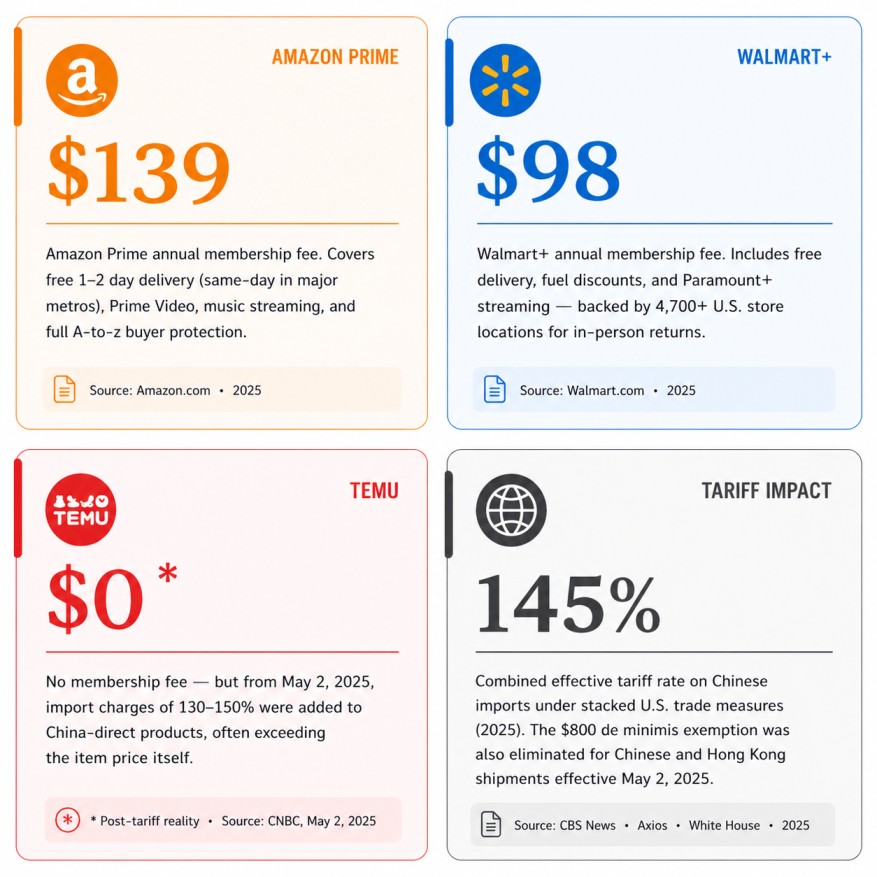
For years, Temu's fee structure was its entire competitive strategy: no membership, free standard shipping, products priced at near-cost from Chinese factories. A charging cable for $1.80. Sneakers for $14. The model worked because of a regulatory loophole — the "de minimis" exemption — which allowed packages valued under $800 to enter the U.S. completely duty-free. The volume of such parcels had surged from 153 million in 2015 to over one billion by 2023, with China accounting for the dominant share.
In spring 2025, the Trump administration imposed a combined effective tariff rate of up to 145% on Chinese imports across stacked trade measures and closed the de minimis loophole for Chinese and Hong Kong shipments, effective May 2, 2025.
“Temu suspended its direct-from-China shipment model for U.S. customers — adding import charges of 130–150% to China-direct products and shifting its platform to display only domestically warehoused inventory. Items shipped from China were labelled "out of stock." The era of $5 goods shipped duty-free from Guangzhou was over. “
— Source: CNBC, May 2, 2025
According to survey data published by Omnisend, 56% of Americans said they were worried the tariffs would drive up prices on Chinese goods, and 29% said they would immediately stop buying from — or significantly reduce purchases on — platforms like Temu if prices rose. Those shoppers were always price-driven, never loyalty-driven. When the price advantage was removed, they left.
Amazon and Walmart, by contrast, source from diversified domestic and global suppliers, maintain established U.S. fulfillment infrastructure, and carry no structural exposure to a single-country tariff shock. Neither had to rebuild its U.S. business model in a week. Temu did.
Refunds & Returns — Where Trust Is Won or Lost
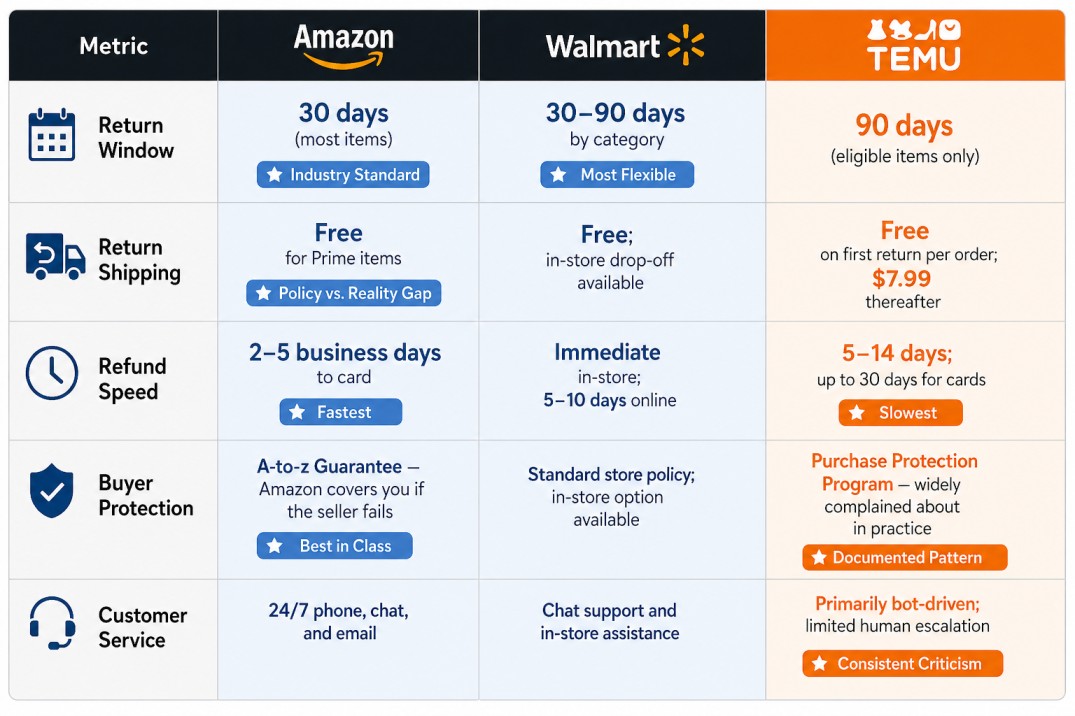
On paper, Temu's 90-day return window looks generous — it is technically longer than Amazon's 30 days. But return policy language and the lived return experience are two entirely different things.
On Amazon, a return takes minutes to initiate. Free prepaid labels are generated automatically for Prime items. Refunds arrive within 2–5 business days. The A-to-z Guarantee means that if a third-party seller fails to cooperate, Amazon itself absorbs the loss. That single promise — that Amazon stands behind your purchase regardless of which individual seller fulfilled it — is what converts a high-volume marketplace into something that feels as reliable as buying from one trusted store.
On Temu, the gap between written policy and lived experience is consistent and independently documented. Reviews across Trustpilot, the Better Business Bureau, and Reviews.io describe bot-driven customer service, refund denials submitted despite proof of return, and disputes that cycle through identical templated responses for weeks. The BBB page for Temu records complaints characterizing its Purchase Protection program as functionally absent when real problems arise — not as isolated cases, but as a pattern documented across hundreds of independent accounts.
Walmart holds the middle ground. Its in-store return infrastructure is the best of the three — walk in, hand over the item, leave with a refund the same day. But its online return experience reflects the same digital underinvestment responsible for its last-place ACSI ranking: workable, but not the kind of experience that builds loyalty.
The Review Problem: Volume, Verification and Integrity
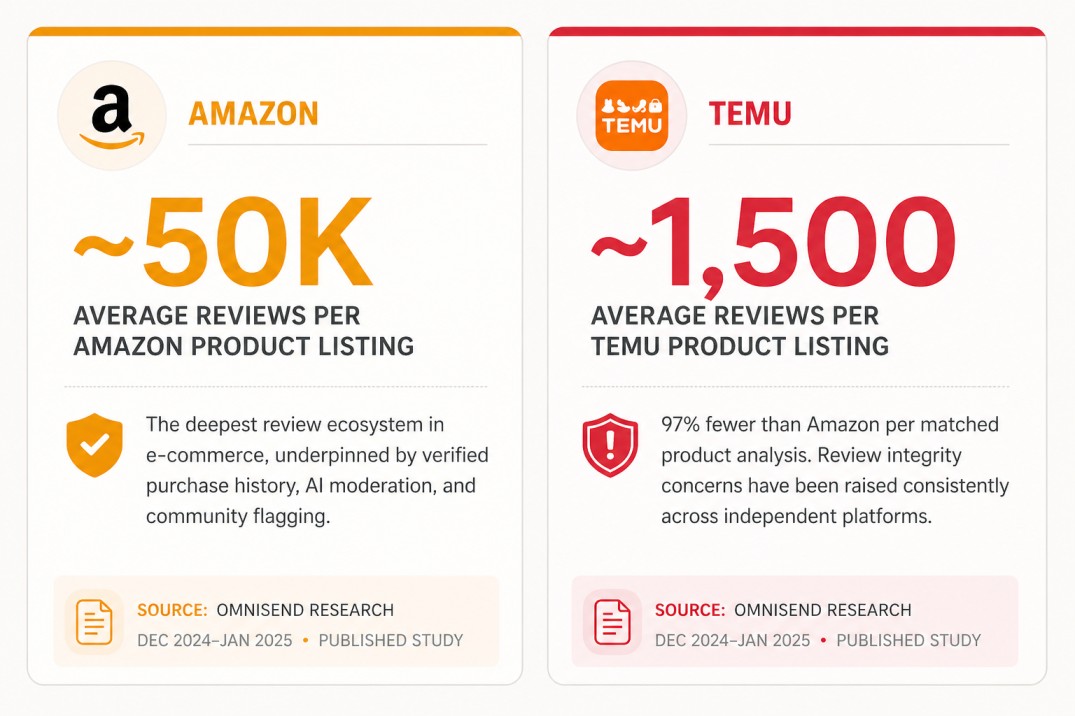
Reviews are the currency of online trust, and the volume gap here is significant. Omnisend's published December 2024–January 2025 analysis of thousands of matched product listings found that Amazon products average approximately 50,000 reviews per listing compared to roughly 1,500 on Temu — a gap exceeding 97%. That difference is not simply about data quantity. Amazon's review ecosystem has depth, verified purchase history, and a moderation infrastructure developed over two decades. Temu's comparatively thin review layer cannot replicate that signal quality.
Beyond volume, there is the question of integrity. Multiple customers across Sitejabber and independent review platforms have alleged that Temu populates five-star reviews on products when buyers do not leave their own feedback. This claim has not been confirmed by any regulatory investigation, and Temu has denied it. Whether or not it is proven, its consistent appearance across independent platforms creates a perception problem that is, by itself, damaging. American shoppers who have grown sophisticated about review manipulation treat even the appearance of gaming as disqualifying. Trust once suspected of being manufactured is almost impossible to restore.
Amazon's own ecosystem has well-documented struggles — the FTC (Federal Trade Commission) has taken action against sellers for fake reviews. But at 50,000 average reviews per listing, with verified purchase flags, community reporting, and AI-based moderation, the signal-to-noise ratio is incomparably stronger. Imperfect — but accountable in a way Temu has not yet demonstrated.
The Verdict: What U.S. Shoppers Should Know in 2026
The ACSI data, the tariff record, the review volume gap, and the customer complaint patterns together form a picture that is clear enough to act on.
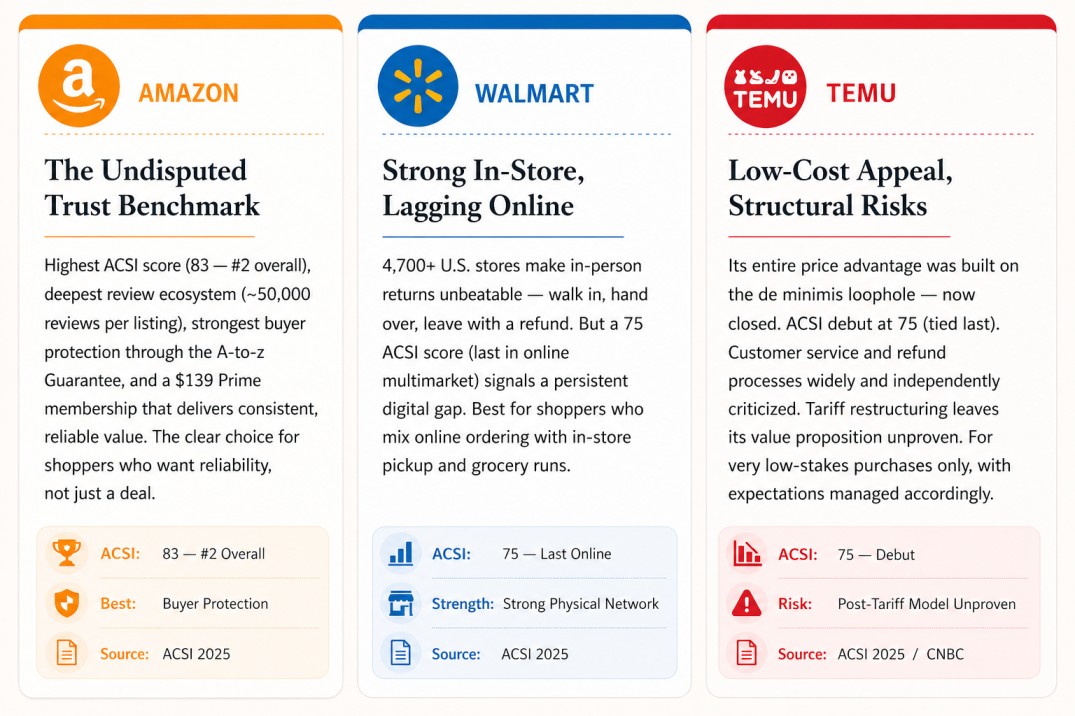
Shoppers in the U.S. check reviews for one reason: can they trust the platform if something goes wrong?
Amazon has spent over two decades proving that it can — through reliable delivery, consistent refunds, and strong buyer protection.
That’s what real trust looks like, and the data backs it up.