
How AgTech Is Powering Sustainable Farming Across the United States
Business to Consumer
January, 27, 2026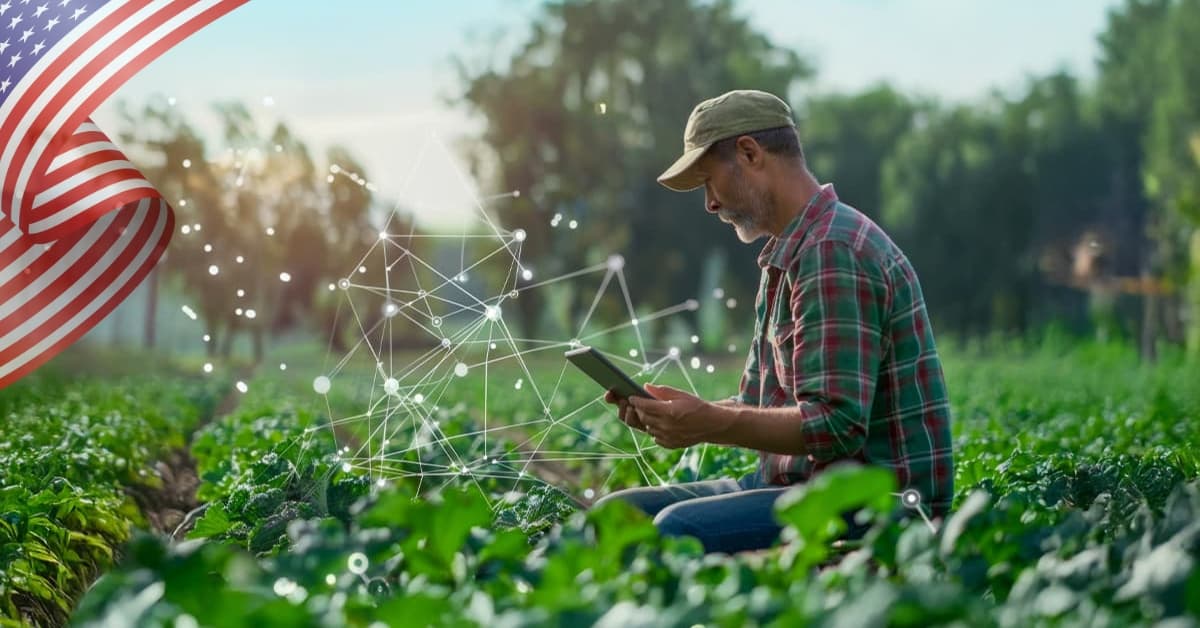
Across the United States, farmers are being asked to do something that sounds impossible: produce more food, fiber, and fuel while reducing environmental impact, protecting soil and water, and staying profitable amid weather volatility. That tension is exactly where AgTech (agricultural technology) is making its strongest case. From AI-driven sprayers that cut chemical use to decision-support platforms that turn field data into input savings, AgTech is increasingly the operating system behind powering sustainable farming at scale.
"Sustainable farming" in a US context usually means resource efficiency (water, fertilizers, fuel), strengthening soil health, reducing greenhouse gas emissions, and building resilience against heat, drought, floods, pests, and market shocks. USDA's climate-smart farming emphasizes practices and systems that improve soil and resilience while reducing emissions and improving efficiency (e.g., reduced/no-till, cover crops, nutrient management, irrigation efficiency).
AgTech doesn't replace agronomics—it modernizes how agronomy is executed. Below is how the technology stack is being applied on American farms, followed by a practical, field-focused list of the Top 10 AgTech Companies in the USA that are shaping this shift.
1. Precision agriculture: doing the "right rate" at the "right place":
The highest sustainability benefit occurs when organizations stop applying more resources than needed. Precision agriculture uses GPS guidance, yield maps, soil maps, variable-rate equipment, and analytics to create customized equipment use that matches specific field conditions.
The USDA Economic Research Service has shown that farmers have widely adopted digital agriculture technologies through their research work, which emphasizes yield mapping, soil mapping, and variable rate technologies as essential tools for modern agriculture.
Sustainability Outcomes:
-
Less nutrient loss to waterways through more accurate fertilizer placement and timing.
-
Reduced nitrous oxide emissions when nitrogen is optimized.
-
Lower fuel use when passes are reduced, and routine is improved
-
Better yield stability by matching seed and inputs to soil potential
What makes it "technical" in 2026: Modern platforms fuse machine data, satellite imagery, scouting observations, and weather forecasts into layers that can recommend variable-rate seeding, spraying, and nutrient plans—then push those prescriptions into field equipment.
2. "See and Spray" and targeted chemistry: cutting pesticide use without losing weed control:
The costs of chemical inputs exceed their current prices because they are subject to strict regulations that government authorities continuously monitor. The AgTech field achieved its most significant advancement through computer vision sprayers, which detect both weeds and crop rows to deliver herbicide treatment only to needed areas.
John Deere's See & Spray system demonstrates its accuracy by directing herbicide application, reducing herbicide use without disrupting operational efficiency. Deer's product page cites cutting herbicide usage by more than 50% (under specific system conditions). Blue River Technology, closely associated with these capabilities, describes See & Spray as enabling Deere sprayers with advanced application technology.
Sustainability Outcomes:
-
Lower chemical load per acre (and often fewer refills/less transport)
-
Reduced off-target impact and potential drift exposure
-
Better economics that can make IPM programs more feasible
3. Data platforms: turning field history into fewer "guess passes":
A sustainable decision is easier when it's backed by evidence: field-by-field performance, hybrid response curves, and input ROI. This explains why farm management systems and digital agronomy platforms have become essential components of AgTech infrastructure.
Climate FieldView operates as an "all-in-one digital solution" that provides growers with data-driven insights. Trimble Agriculture develops software that enables farmers to plan their field operations and execute them, tracking their activities and maintaining records throughout the crop year.
Sustainability outcomes:
-
Fewer unnecessary field operations (fuel + compaction reduction)
-
Improved timing (spray window, irrigation scheduling, harvest logistics)
-
Better documentation for audits, conservation programs, or supply chain requirements
4. Water and irrigation tech: sustainability where every inch matters:
In water-stressed regions—especially across the West—the AgTech sustainability story often starts with irrigation efficiency. While irrigation hardware has evolved for decades, the step-change is sensor + model + automation:
-
Soil moisture probes + evapotranspiration modelling
-
Variable-rate irrigation, where systems support it
-
Alerts for leaks, pump efficiency issues, and scheduling conflicts
-
Integration with weather forecasts to avoid watering ahead of rain
Even when yield gains are modest, water savings can be transformative for groundwater and long-term farm viability.
5. Soil health and climate-smart measurement: from "practice" to "proof":
Sustainability claims require verification to protect organizations that use sustainable claims to justify premium costs, financing options, and carbon programs. The demands now drive growth in the Measurements Reporting and Verification system, which tracks agricultural practices such as cover crops, reduced tillage, nutrient management, and grazing plans.
The USDA has established official technical guidelines for climate-smart practices, which include methods to measure and verify emission reductions across specific commodity pathways.
Sustainability Outcomes:
-
Improved soil structure and infiltration
-
Better drought resilience and reduced erosion risk
-
Stronger documentation that can unlock incentives
6. Controlled environment agriculture: sustainability benefits and complex economies:
Vertical farming and indoor systems aim to decouple production from weather extremes while decreasing land requirements and pesticide applications. Plenty uses resources to sell pesticide-free greens but also faces industry challenges, including its current business transformation.
Controlled environment Agriculture has the potential to improve sustainability by optimizing water use and strengthening local supply chain reliability. Still, its overall environmental impact depends primarily on the energy sources and operational methods used.
Top 10 AgTech Companies in the USA (and how they support sustainable farming):
Below is a practical, farm-relevant list of AgTech Companies, mixing equipment, software, biological innovation marketplaces, and controlled-environment systems. (Some are US-headquartered; others are deeply embedded in US farming systems):
1. John Deere (Precision AG, Automation, targeted spraying):
Deere's precision ecosystem spans guidance, machine data, and advanced application systems like See & Spray, designed to target inputs more precisely and reduce over-application.
2. Blue River Technology (computer vision for crop care):
Blue Rivers has been a major driver of camera-and-AI-based "apply only where needed" approaches and has been publicly tied to See and Spray capabilities.
3. The Climate Corporation (Climate FieldView):
FieldView is widely used in the US row-crop decision workflow, capturing field data, visualizing variability, and supporting more disciplined, data-based input decisions.
4. Trimble Agriculture (guidance, data, nutrient efficiency workflows)
Trimble's platform connects hardware (positioning/guidance) with farm data management and operational records—enabling more efficient field operations and better nutrient planning.
5. Corteva Agriscience (Granular, digital agronomy tools):
Corteva's granular tools focus on planning and analysis across fields and seasons, strengthening decision discipline around seed performance and crop plans.
6. CNH Industrial (precision agriculture via Raven integration):
CNH expanded its precision agriculture capabilities through Raven Industries, a key player in precision application and field tech.
7. Farmers Business Network (FBN) (Marketplace + Farm Network Data):
FBN positions its platform to help reduce production costs and improve market access through an extensive member network and procurement/market tools.
8. Indigo Ag (soil, sustainability programs, and network data):
Indigo Ag is often associated with sustainability-linked farm programs and measurement-driven approaches in US agriculture (commonly referenced among leading AgTech lists).
9. Pivot Bio (biological nitrogen solutions):
Pivot Bio is frequently cited among the leading Agtech innovators for biological approaches aimed at improving efficiency (often framed as reducing dependence on synthetic N in some systems).
10. Plenty (controlled environment/indoor farming):
Plenty represents the controlled-environment branch of AgTech, pursuing pesticide-free production and resource-efficient indoor growing while navigating the sector's recent financial volatility.
What "Powering Sustainable Farming" looks like on a real US farm:
Sustainability isn't one tool—it's a system. In practice, farms that get measurable results tend to layer:
-
Baseline mapping: Soil tests + yield history + drainage/terrain
-
Variable-rate plans: Seed + nutrients + lime (where relevant)
-
Targeted crop protection: Smart scouting + thresholds + precision application
-
Operational efficiency: Guidance + section control + fewer passes
-
Proof: recordkeeping + audit/MRV when premiums or programs require it
The compounding effect matters: a modest nutrient optimization, fewer passes, and targeted spraying often deliver larger environmental benefits than any single "silver bullet."
The constraints AgTech must solve next:
Even with strong momentum, adoption isn't automatic. The most significant US constraints are
-
Connectivity gaps in rural areas (limit real-time workflows).
-
Interoperability (moving data cleanly between brands/platforms)
-
Upfront cost + training (especially for smaller farms)
-
Trust and ROI proof (farmers need repeatable economics, not demos)
Some policy and standards discussions explicitly highlight enabling IoT and digital adoption as a public interest area for US agriculture modernization.
Final Takeaway
AgTech has become an essential part of contemporary American agriculture because it has transformed from a voluntary innovation into a critical industry requirement. The article demonstrates that sustainable farming operations throughout the United States now depend on technological systems that enable agricultural producers to create better environmental solutions through their work. The farm industry enters a new phase of development through the combined use of precision agriculture, AI-powered equipment, digital agronomy platforms, biological products, and controlled environment systems, which create innovative methods for food production while maintaining environmental protection.
Sustainability measurements have reached their current state because the Top 10 AgTech Companies in the USA now operate sustainable business models that generate measurable environmental impact through economic practices. AgTech solutions enable farmers to adopt sustainable production practices while maintaining land health by reducing waste, improving soil conditions, managing water resources, and boosting their capacity to adapt to climate change. The technology aligns with actual farming requirements by focusing on operational efficiency and financial returns, which users can practically implement rather than pursuing ideal sustainability targets.
Looking ahead, the continued success of AgTech will depend on interoperability, rural connectivity, farmer training, and supportive policy frameworks. When technology, agronomy, and farmer expertise align, sustainable farming shifts from a challenge to a competitive advantage. In this way, AgTech is not only modernizing U.S. agriculture—it is securing its future by ensuring that productivity and sustainability grow together, season after season.